
Funky Fresh

You may have noticed that my recent bread recipes have called for fresh yeast, not the more commonly called for dry active yeast. Now, I’ve received quite the influx of emails inquiring about this switch, and before my inbox reaches critical mass, it seems like high time to address all of these inquiries!

Found in the refrigerated section of some standard grocery stores, it can be a hit-and-miss search trying to locate these little squares. They’re sold in both 0.6-ounce and 2-ounce cakes, but I’ve only been lucky enough to find the smaller sizes, and only some times, at some stores. However, if you see any sort of yeast on the shelves, you can probably request that the store you frequent stock fresh yeast for you, or at least put in a special order.

When I get my little cubes home, I tend to store them all together in a zip-top plastic baggie, since the foil wrappers are always applied so haphazardly that they tend to slide off the moment you pick one up. It also helps keep them in one place so that they’re easier to find- Such tiny packets are easy to lose in the chaos of my overstuffed fridge!

Otherwise, you can certainly find it for sale online, but in most cases, it will only be sold in bulk. Unless you plan on doing a heck of a lot of baking, I would recommend against buying such a large volume at a time, since fresh yeast is far more perishable that dried, and a little bit goes a long way. Fresh yeast should be stored in the refrigerator prior to use, but you can stock pile it in the freezer for up to 4 months as well.

In case all of that seems like too much of a hassle for you, you can always substitute one 1/4-ounce package of active dry yeast (not rapid rise) for one 0.6-ounce cube of fresh yeast. But before you give up on the notion, just check out what you’d be missing…

Both of these loaves were made from the same exact recipe, but the one on the left was made with fresh yeast, on the right, dried. As you can see, the left loaf rose higher and more evenly, with a finer crumb. What you can’t see is how much better it tasted- Bearing a more pronounced yeast flavor, it’s a much more complex and nuanced loaf. Both the texture and taste keep bringing me back to this leavener, and once you try it out for yourself, I promise it will become a staple ingredient in your home too.

Falling for Pumpkin

As if suddenly freed from the restraints of summer’s final days, autumn’s official first day saw me clamoring back into the kitchen, scheming up new ways to reintroduce my favorite orange gourd once back into my diet. Pumpkin is just one of those endlessly versatile ingredients that can be prepared any way you can imagine- Be it sweet or savory, salty or sour, crunchy or creamy- And still never get old. It may be hard not to rely on this multifaceted squash for cooking inspiration in the days to come, being such a perfect flavor for the fresh season and all, but I’m not holding back today, not when the leaves are turning and the air itself carries the essence of fall!

If there were anything more cozy than a pumpkin dish for an unexpectedly chilly day, it would definitely be a pumpkin bread. But this time, my sweet tooth was no where to be found, relenting to the otherwise quiet desire for something a bit more savory. No need to compromise though, a yeasted pumpkin bread that leaned more on salt than sugar fits the bill just fine.

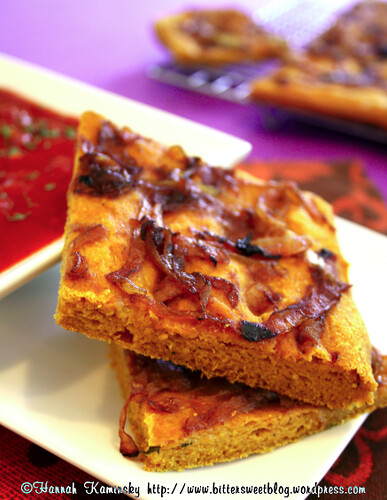
Lightly spiced with a dash of nutmeg and a pinch of sage, this bright orange bread is in truth an attempt at focaccia gone awry, but I prefer to think of it merely as a flat bread, better suited to accompany a nice warm soup anyway, if you ask me. While it would be delicious by itself, the topping of soft caramelized onions is what makes this otherwise simple bread stand out, putting it heads and shoulders above any other plain pumpkin loaf. There is one problem with it though- It seems to magically disappear if you leave it on the counter for a day!

Yield: Makes 12 - 16 Servings

Pumpkin Flat Bread with Caramelized Onions

Pumpkin Flat Bread with Caramelized Onions

Lightly spiced with a dash of nutmeg and a pinch of sage, this bright orange bread is topped with caramelized onions for a sweet and savory finish.

Prep Time 25 minutes
Cook Time 1 hour 45 minutes
Additional Time 9 hours
Total Time 11 hours 10 minutes

Ingredients

Pumpkin Focaccia:

  • 3/4 Cup Warm Water
  • 1 Teaspoon Agave Nectar
  • 1 0.6-Ounce Cube Fresh Yeast or 2 1/4 Teaspoons Active Dry Yeast
  • 3 Cups White Whole Wheat Flour
  • 1 Teaspoon Salt
  • 1/4 Teaspoon Ground Nutmeg
  • 1/2 Teaspoon Chopped Dried Sage
  • 2 Tablespoons Olive Oil
  • 1 15-Ounce Can Pumpkin Puree

Caramelized Onions:

  • 1 Tablespoon Olive Oil
  • 3 Medium Yellow Onions, Thinly Sliced
  • Pinch Salt
  • Pinch Pepper
  • Pinch Baking Soda

Instructions

  1. In a small bowl, stir together the warm water and agave, and crumble in the fresh yeast. Stir to combine, and let sit for 5 minutes.
  2. Sift the flour into your stand mixer, along with the salt, nutmeg, and sage, and mix briefly before pouring in the yeast mixture. Install the dough hook attachment before proceeding, as things may get a bit sticky from here on in. Add in the pumpkin puree and olive oil, and let the mixer slowly incorporate these wet ingredients. Scrape down the sides of the bowl as necessary, until there are no remaining patches of dry flour. Continue running the machine, allowing it to kneed the dough for about 10 minutes. It should still be rather wet and sticky, but much smoother than before. Transfer the dough into a lightly greased bowl, cover with plastic wrap, and let it rest in the refrigerator overnight, or about 8 – 10 hours.
  3. In the morning, take the bowl of out the fridge to let it come to room temperature while you deal with the topping. Peel and cut the onions in half, from pole to pole, and slice them thinly. Place a pan over moderate heat and pour in the oil. Add the onions, followed by a pinch of both salt and pepper, and just the tiniest dash of baking soda. (This helps the caramelizing process move a bit faster- You can leave it out if you’d prefer, but you shouldn’t taste it in the end.) Stirring every couple of minutes, cook the onions until the reach a light brown hue, but be careful not to take them too dark, as they’ll continue to cook in the oven. Remove the pan from the heat and let cool.
  4. Grease a 15 x 10-inch jelly roll pan and set aside.
  5. Turn the dough out onto a lightly floured surface, and use your fingers to press it out into more or less of a rectangle. Fold it over itself like a letter, press firmly, and turn it. Repeat this a few times, until the surface seems smooth. Transfer the rectangle into your prepared pan, and once again use your fingers to coax it out into the corners. It may seem like not enough dough, but it will cover the pan with a bit of persuasion. Let rise at room temperature for about one hour.
  6. Meanwhile, begin preheating your oven to 375 degrees. When the dough seems almost ready, poke it like you would a focaccia to give it a slightly bumpy-looking surface. Spoon the onions evenly over the top.
  7. Bake for 35 – 45 minutes or until the loaf is nicely browned on the bottom (remove the bread from the oven and use oven mits to peek underneath, being very careful not to burn yourself of course!) Depending on how dark you cooked you oven, you may wish to tent the loaf with aluminum foil after about 20 minutes to prevent them from burning. Let cool on a wire rack.

Recommended Products

Please note that some of the links above are affiliate links, and at no additional cost to you, I will earn a commission if you decide to make a purchase after clicking through the link. I have experience with all of these companies and I recommend them because they are helpful and useful, not because of the small commissions I make if you decide to buy something through my links.

Nutrition Information:

Yield:

16

Serving Size:

1

Amount Per Serving: Calories: 128Total Fat: 3gSaturated Fat: 1gTrans Fat: 0gUnsaturated Fat: 3gCholesterol: 0mgSodium: 150mgCarbohydrates: 22gFiber: 4gSugar: 2gProtein: 5g

All nutritional information presented within this site are intended for informational purposes only. I am not a certified nutritionist and any nutritional information on BitterSweetBlog.com should only be used as a general guideline. This information is provided as a courtesy and there is no guarantee that the information will be completely accurate. Even though I try to provide accurate nutritional information to the best of my ability, these figures should still be considered estimations.

Save the Date

Come 2010, there will be a whole new reason to look forward to each new day… With the Crochet-a-Day calendar!  Yes, this fun page-per-day timetable has been around for a few years already, in addition to its sister Knit-a-Day calendar, but this next year’s edition is especially worth checking out.  Packed with a couple hundred creative new designs that are sure to get you inspired every morning when you flip the page, this one will also include a certain pattern that has some additional significance to me…

On May 19, 2010, my Basic Birds, the very first crochet pattern I ever wrote, will be featured!

Having been translated into over a dozen different languages and used to create a couple hundred little birds, I could have never imagined that this simple project would have become such a sensation.  An easy first amigurumi for newbies, or quick diversion for the more advanced, the fun part is how easy it is to make your own.  Each little face is slightly different, the shape of the body unique to the hands that made it.  So, how will yours be different, intentionally adapted or not?  If you don’t want to wait for the calender, and all of the other fun patterns that come with it, the free pattern is right where it’s always been.

Lend Me Your Ears

Labor Day weekend is upon us, a gracious three-day weekend that’s always welcome, but to most people means little more than just that- A day off from work or school. Heck, I couldn’t tell you its true significance, but I can tell you what it means to me at least: Summer’s last hurrah. One last chance to throw that barbecue, picnic, or party that you never made the time for earlier. One more opportunity to rejoice in the bounty of the season, to celebrate those late tomatoes that are just now finally hitting their peak of perfection. Above all else though, for me, Labor Day means corn. Juicy, sweet as sugar, fresh summer corn right off the cob needs only a pinch of salt to reach unparalleled gastronomic heights. No labor day is complete without a least two or three ears (per person, please!) on hand.

It feels like a crime to do much more than just eat such flawless corn, but I simply couldn’t help exploring other possibilities after stumbling across a particularly sweet batch. Simplicity was key here, so it was practically destined to become something so simple, so homey, and so quintessentially American as a humble pound cake.

It’s absolutely crucial to use the best corn you can possibly get to make this tender cake shine. Don’t wait around before busting out the baking pan and starting your oven; its sweetness begins to wane mere hours after the ears have been plucked from the fields, and that ephemeral flavor will be irretrievably lost.

Though subtle in flavor, the delicate essence of corn is definitely present if you’re looking for it, and if not, you’ve got one stellar basic pound cake anyway. The perfect canvas for toppings like ice cream, vegan whipped cream, jams, ganache, icing, and pretty much anything else sweet, I dare say it’s quite possibly the best pound cake I’ve ever made, bar none. And I’m usually not one for such superlatives, either.

Yield: Makes 8 Servings

Sweet Corn Pound Cake

Sweet Corn Pound Cake

The delicate flavor of fresh sweet corn sparkles in this simple, tender pound cake. It's delightful on its own or dressed up with fruit, whipped cream, or even chocolate ganache.

Prep Time 10 minutes
Cook Time 1 hour
Total Time 1 hour 10 minutes

Ingredients

  • 1 1/2 Cups Sweet Corn Kernels (From About 3 Ears)
  • 2 Cups All Purpose Flour
  • 1 Teaspoon Baking Powder
  • 1/4 Teaspoon Baking Soda
  • 1/2 Teaspoon Salt
  • 1/2 Cup Vegan Butter, at Room Temperature
  • 3/4 Cup Granulated Sugar
  • 1/4 Cup Dark Brown Sugar, Packed
  • 1 Teaspoon Vanilla Extract
  • 1/2 Teaspoon Apple Cider Vinegar

Instructions

  1. Preheat your oven to 350 degrees, and lightly grease and flour an 8 x 4-inch loaf pan. Set aside.
  2. First, pop your corn kernels into either a food processor or blender, and very thoroughly puree them, until absolutely silky smooth. This isn’t some rustic corn bread; You don’t want any big chunks left over. This could take up to 5 minutes, depending on your machine.
  3. Meanwhile, sift together the flour, baking powder and soda, and salt, mixing well so that all of the ingredients are equally distributed. Set aside.
  4. In you stand mixer, install the paddle attachment, and beat the vegan butter briefly to soften it. Add in both sugars, and cream thoroughly, until homogeneous. Bring the mixer to a halt before adding half of the dry mixture, and start it again on low speed.
  5. Mix until you get fine crumbs, and then pour in all of the corn puree, along with the vanilla and apple cider vinegar. Mix again so that the batter smooths out, and then incorporate the final half of the dry goods. Stir just enough to achieve a smooth mixture, and transfer the batter into your prepared pan.
  6. Bake for 50 – 60 minutes, until golden brown and a skewer inserted into the center comes out clean. The top of the cake may develop a fissure right down the center, but don’t worry- I feel that this crack only adds to it’s homespun charm.

Recommended Products

Please note that some of the links above are affiliate links, and at no additional cost to you, I will earn a commission if you decide to make a purchase after clicking through the link. I have experience with all of these companies and I recommend them because they are helpful and useful, not because of the small commissions I make if you decide to buy something through my links.

Nutrition Information:

Yield:

8

Serving Size:

1

Amount Per Serving: Calories: 338Total Fat: 12gSaturated Fat: 2gTrans Fat: 2gUnsaturated Fat: 9gCholesterol: 0mgSodium: 236mgCarbohydrates: 54gFiber: 2gSugar: 26gProtein: 4g

All nutritional information presented within this site are intended for informational purposes only. I am not a certified nutritionist and any nutritional information on BitterSweetBlog.com should only be used as a general guideline. This information is provided as a courtesy and there is no guarantee that the information will be completely accurate. Even though I try to provide accurate nutritional information to the best of my ability, these figures should still be considered estimations.


Raw for Dessert

It seems that raw foods are all the rage these days, at least in health-conscious circles and for more open-minded foodies. It can be a proposition that’s a bit difficult to swallow, whether you follow the guidelines in full or attempt a diet of partially raw edibles and cooked dishes, due to difficulty more than anything else. Preparing a few simple snacks such as crackers or cookies? No problem, only it will take you at least half a day to dehydrate anything to the point of approaching crispiness. Craving something comforting like meatloaf or veggie burgers? Easy enough to fix, but you may just need to hunt down rare, hard to find ingredients online. The worst offenders, however, tend to be the desserts. Typically requiring crazy equipment, expensive ingredients, and up to two days of waiting before you can even take the first bite, it’s hard for this die-hard baker to fully embrace such a diet.

That doesn’t mean I would snub a whole wide universe of vegan food, simply based on the concept of applying no heat above 110 degrees. Always eager to try new things, I was excited to get my hands on a promising new book called Raw for Dessert, by Jennifer Cornbleet. Ranging from your standard raw fruit desserts to more elaborate ice cream sundaes and layer cakes, you definitely have a good variety to choose from.

Skipping over the simpler fare and diving right into- What else?- The ice cream section, I quickly decided that the Cookies and Creme Ice Cream was an absolute must-make.

Made from a base of brazil nuts, cashews, and agave, this frozen treat is nothing if not rich. Chunks of raw chocolate pie crust are mixed in at the last moment for the “cookies,” and even your seasoned ice cream pro might be fooled into thinking that this was a traditional treat. Surprisingly not as nutty as I had expected it to taste, a quality vanilla extract can really shine and lend a great depth of flavor here. Best served within a few days, lest it become too hard to scoop, the texture is perfectly creamy, accented nicely with an occasional chocolatey crunch. I would gladly make this one again, and again, and again.

Unfortunately, the Mint Ice Cream wasn’t nearly as big a hit. What I would have given for just a touch more sweetness, and just a bit more mint flavor! Although the color was a gorgeous, natural green, that was about the only vibrant thing about it.

Nuts about coconut? I sure am, and I was pleased as punch to see that it gets plenty of usage throughout this book. Wanting to focus on the fresh flavors of whole coconut, the Coconut Creme Pie sounded like a perfect showcase. Making mine into individual mini pies, it was only a matter of blending, forming the crust into tins, and blending some more, before a brief chill and all was done. Delightfully smooth and creamy, with nothing to impede the pure coconut essence, it’s hard to believe these were created without the aid of any heat, or refined sugars even!

Finishing off my trial run with a bang, it seemed only right to test the waters for a true chocoholic. Terribly curious as to what a raw Chocolate Lava Cake might taste like, I whipped out that raw cacao powder and bag of walnuts faster than you could preheat an oven. This is one simple yet incredibly impressive dessert that may very well convert full-fledged carnivores to the idea of raw foodism. Deeply chocolaty and fudgy all around, breaking into the flowing center is like opening up a sweetly wrapped present, to discover jewels inside. If you were to only make this one dessert in the whole book, it would still be worth the price.

Happily, all you need to make such desserts is just a sturdy blender or food processor, no fancy dehydrator required. I would argue that it could use a few more pictures, as only a couple of centerfolds are scattered throughout, but then I am a bit spoiled when it comes to cookbook photography. Clear instructions make each recipe a breeze to follow, and although almost all require serious servings of raw nuts, often making for a very expensive, high-fat venture, I would argue that it’s nothing outrageous for a healthier, yet still truly decadent dessert.

[Written for Go Dairy Free]