Mirror, Mirror, On the Set

When I first posted about using mirrors to accentuate available light for photography instead of adding in more light sources, there were a lot of requests for side-by-side comparisons. As a visual learner, I couldn’t have agreed more that it would be helpful to see this difference, so here’s a shot I took yesterday, with and without a mirror.

(Yes, the angles are slightly different, but I wasn’t using a tripod.)

Admittedly, it’s a very small change here, and those who skim quickly over their pictures will easily miss it, but it makes a world of difference to my eyes. Before adding a single mirror right in front of the plate, the close side of that pie was plunged into darkness, obscuring details, lacking color, and hiding texture. It makes the whole picture look very dark to me, since it’s already on a black background. With the mirror in place, it just seems to brighten up the whole composition, and really put a spotlight on the pie at the same time.

I wouldn’t blame you if you’re not dying to run out and buy a mirror after seeing this, but if you ask me, it’s worth the [very small] investment. This is just one mirror- Imagine what a handful of them could do for a dark set. It’s the small details that count, right?

Oh, and that pie right there? That will be part of an e-book I’m working on, which you’ll be hearing more about very soon…!

Learn By Example

So now we’ve talked about lighting for food photography and the general consensus is that more is better, right?  Most of the time it doesn’t hurt to brighten up your shots a bit, but there are times when the picture starts to become too “hot.”  This happens more often on professional sets since the lights are more powerful, but I’m sure you’ve noticed it when shooting primarily on white plates, too.  The edges become blown out and disappear into the background, or all-white objects loose their definition and become impossible to distinguish.  Before watching Lou in action, I was clueless as to how I should prevent this from happening, other than bringing all the lights down and darkening the entire picture (which often just led to a dark, unappealing shot.)

Just like you would set up mirrors or white bounce cards, these situations call for black bounce cards. Seeing these set up to bring a bit shadow into this shot of a date cake was one of those “ah-ha!” moments, when it the solution seemed so obvious and yet never occurred to me before seeing it work.

While a well-lit shot is always a necessity, it’s important to keep a balance of light and shadow in every picture, so it’s worth the investment of a few dollars to get a small piece of black foam core.

Behind the Scenes

Staying awake many late nights with this one incredible text propped up on my bed, Lou Manna’s Digital Food Photography is nothing short of dreamy, and yet it never put me to sleep, even as the clock crept deep into the AM hours. Drooling over the glossy pages and flawless photos, I entertained the fantasy that one day I might be able to do this sort of thing on a professional level. Many years from now after endless amounts of practice, perhaps a few classes, and probably a kindly investor, it seems like it could be such a glamorous and exciting job. Clearly the lack of sleep was getting to me, but still, I couldn’t stop thinking about it and wondering how it all happened, what a real food photo shoot would be like. Compelled by this sudden urge, I shot off an email to the man himself and abruptly asked to become his apprentice. The moment that email was fired into cyberspace, I was horrified; it was practically the internet equivalent of drunk dialing, and there was no taking it back now.

Well, much to my disbelief, a response came back almost immediately, and it sounded at the very least like a gentle let-down, and at best, a far-fetched possibility. Never in a million years could I have imagined that a day or two later I would receive a phone call from him, inviting to come see how it was all done back at his studio, and maybe even lend a hand. Words can’t even describe how thrilled and honored I was to be invited back.

So, on to the fun stuff- How does it all happen? Well, I was surprised to learn that it was very similar to what I do… Only on a much larger [and much more expensive, much more skilled] scale. I was lucky enough to see the prop stylist and food stylist in action- Truly a sight to behold. To simplify things, here’s the basics of what goes on behind the scenes…

The table and lights are set up, and Lou checks the brightness and color balance. He has a fancy light meter to check which F-stop would be best to use, and a color card to make sure that the camera is reading them all correctly. This saves a lot of time fiddling with the settings to prevent blues from looking green or purple, and other unfortunate discolorations. Lou shoots tethered, which means that he has the camera connected to a tv monitor and can view the pictures as he’s taking them. As you can clearly see from this full screen image, this color setting isn’t the right one- Still too much magenta.

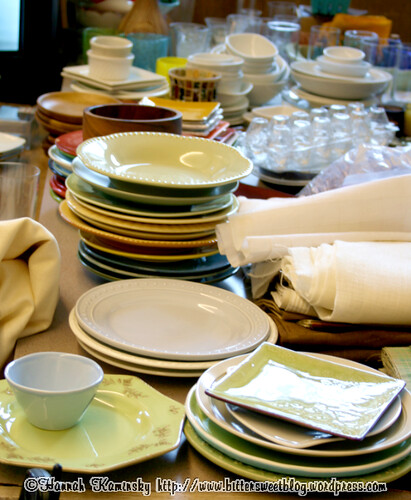
Once the camera settings are nailed down, the prop stylist goes into action, picking out the background, linens, dishes, and props. Got enough choices there? Don’t worry, this isn’t even the half of it!  Fabrics are ironed if there are any wrinkles or creases, glasses are polished, and sometimes dishes need a little dusting before they take their place on the set.

Meanwhile, the food stylist has been hard at work cooking the dishes and then gussying them up for their time in the spotlight. What might look like a simple bowl of butternut squash puree actually has a number of layers beneath it so that it appears to be a heaping serving; An overturned bowl within the dish gives it most of its height, but it’s also supported by a mound of mashed potatoes, and even a few paper towels. Crazy to think about it all! The whole thing is crowned with a few artful swirls, much like a delicate layer cake, and it’s off to the set.

Mmm, squash.

Everyone in the studio gathers around the monitor and adds their two cents to each photo as it appears on the screen. Dishes are rearranged, switched out, cleaned up; garnishes are added, adjusted, replaced as they wilt under the hot lights; mirrors and reflectors are added and moved until each side of the shot is perfectly lighted. The camera angle and zoom is adjusted, until it the plate fits on the screen perfectly.  Each small tweak brings us closer to the final image, a perfect composition that looks good enough to eat. Lou takes a number of shots that are potential winners, offering the client 5 or 6 to choose from, and it’s on to the computer they go.

Adjustments are made in Photoshop if need be (but I don’t believe this set required any, if I remember correctly), and then the pictures were emailed to this particular patron. Waiting with baited breath, the set is left undisturbed until the final okay comes in from the happy client. Finally, the “hero” dish is taken away, nibbled at (if at all edible) and then tossed. The backdrop is replaced with a new set of linens and props, and we’re ready to move on, full steam ahead, into the next shoot. Just like that, four dishes that I had previously deemed “extremely unphotogenic” ended up with stunning pictures.

So in a nutshell, it was an unbelievable, incredible, possibly once in a life time experience that taught me a lot and will always stay with me. Thanks to my new photography guru, Lou, I’m inspired to continue working to get the best pictures, even from the most difficult subjects.

One Perfectly Lit Salad

No one ever warned me about the addictive nature of food photography. That’s right, it’s a very slippery slope; It begins just as a fun little past time, taking snapshots of some meals you had, a few treats you want to remember, all innocent fun. But before you know it, you get in so deep that you must stage every shot, cook and bake specifically to photograph the end results, wind up spending hundreds of dollars on a new camera, lenses, a tripod, lights- And you know what? The pictures still aren’t top notch. It takes much more than fancy equipment to take decent photos, and I realize now that I’ve been using them too much as a crutch, and without even fully understanding my camera. Recently, this field has been drawing my attention more and more, and I want to dig even deeper still.

This past Sunday, I had the privilege of not only meeting Lou Manna, but taking his food photography class, in a group of 9 other photo-enthusiasts. I couldn’t even begin to share the tips and teachings that I pick up from those 7 1/2 hours, but I would encourage you to sign up for his next class if you’re interested. Believe me, it’s worth the cost and effort of getting into NYC, if you’re not local.

One thing that really opened my eyes was the lighting demonstration. Poor lighting is a common complaint for any photographer, beginner or pro, and it was just incredible to see how easily dark spots on a subject can be remedied. For example, here’s my haphazardly arranged salad, with one overhead softbox and one strobe:

Pretty dark, huh? All of those leaves create tons of shadows, and the radicchio is a deep purplish brown to begin with. Now, without adjusting the camera settings, moving the current lights, or adding any more, Lou helped me to achieve this:

Magic! And, a whole bunch of mirrors. By using mirrors to bounce back the available light, it wasn’t as harsh as shining a light directly into the salad greens, but still bright enough to bring some detail into those shadows.

As you can see from the set up, it only took three mirrors and one white card to make all the difference. Pretty amazing stuff, if you ask me.  This one class is going to stay with me for a long time… Not only was it a wonderful learning experience, but Lou is such a nice guy, it would be impossible to walk away from this workshop without a smile on your face.  Seriously, think about taking his class if this sort of stuff appeals to you at all- I can’t recommend it highly enough!