The First Tomato

There was just one single, solitary red orb, positively radiating life like a bright beacon in the night; it stuck out like a sore thumb in that sea of emerald green foliage. Though only the size of a marble, it weighed heavily in my mind, as every day it grew redder and more ripe. Grown from microscopic seeds, those supporting vines were the plants that no one believed would even grow. Sewn in unfriendly New England soil, known in particular for its abundance of large rocks, in a postage stamp-sized garden with moderate sunlight at best, planting them was a long shot from the start. By some miracle, and no small amount of love and long hours of weeding by my mother, those historically fickle plants not only grew, but eventually flowered, and then- Get this- Fruited. Such an ordinary act of nature that thousands upon thousands of gardeners must witness every year, but every time I gaze out at that patch of prolific greenery, I can’t hide my awe. We have our first tomato, perfectly shaped and colored, albeit of miniature size. But heck, size doesn’t matter. It could be as small as the head of a pin for all I care. That fact that it came into existence right here in my backyard, and is undeniably, utterly alive, well… I can’t think of anything that would taste quite so sweet.

Super Summer Soup

Gardeners everywhere are now harvesting the first and second rounds of the summer’s bounty, their sweat and tears paying off in ripe, juicy fruits and vegetables. In come the tomatoes, beans, and of course, zucchini. Whether they’re living on the east coast, west coast, or in between, just about every person who has a square foot of fertile land seems compelled to dedicate it to zucchinis. Such an easy-going and prolific plant, those green vines are more than happy to sprawl out and replicate endlessly anywhere; no environment is too unfriendly, it would seem. And thus, as we enter into the heat of August, we too enter into the season of zucchini. Like an invasive species, there’s no stopping these green cucurbits from taking over gardens everywhere, and filling up refrigerators with bottomless bowls of squash, large and small, sweet and bitter, but all of them the same; Delicious.

Personally, zucchini overload has never been a problem for me. Quite possibly because even such a hearty plant refuses to ever develop into more than a tangle of limp vines under my care, I’m one of those people that envies those complaining about how to use up their overwhelming yields. Regardless, this time of year screams “zucchini!” loud and clear, so who am I to ignore such firm prompting? Into the kitchen with store-bought but still local squash I went.

When it comes to soups, it doesn’t get much easier than this. Yes, you must bear the heat of the oven for a solid half hour, but suit up with ice packs or even bags of frozen peas if you have to, because it’s so utterly worth the pain. With only chopping and no further hands-on labor required, it’s a small sacrifice to make.

Satisfying and filling thanks to the addition of gently crisped chickpeas, but still light and refreshing due to the simple sea of broth surrounding them, zucchini never felt more at home outside of the field than in this concoction. Highlighting their fresh flavor, slightly sweetened by drawing out the natural sugars while roasting, this is the kind of soup that I’m happy to eat both hot and cold. On such oppressive summer days, however, I do highly recommended going the chilled route.

Yield: Makes 2 – 4 Servings

Roasted Zucchini and Chickpea Soup

Roasted Zucchini and Chickpea Soup

Satisfying and filling thanks to the addition of gently crisped chickpeas, but still light and refreshing due to the simple sea of broth surrounding them, zucchini never felt more at home outside of the field than in this concoction. Highlighting their fresh flavor, slightly sweetened by drawing out the natural sugars while roasting, this is the kind of soup that I’m happy to eat both hot and cold.

Prep Time 5 minutes
Cook Time 45 minutes
Total Time 50 minutes

Ingredients

  • 1 Medium Yellow Onion, Roughly Chopped
  • 2 Medium Zucchini, Quartered and Chopped into Bite-Sized Pieces
  • 1 15-Ounce Can (1 3/4 Cups Cooked) Chickpeas
  • 2 – 3 Small Cloves Garlic, Unpeeled
  • 2 Tablespoons Avocado Oil or Olive Oil
  • Salt and Pepper
  • 2 Cups Vegetable Stock
  • 1 – 2 Tablespoons Nutritional Yeast
  • Fresh Parsley, as Needed

Instructions

  1. Preheat your oven to 400 degrees, and line a baking sheet with aluminum foil. This makes for really easy clean-up; all you have to do is toss the aluminum when you’re all done, no washing required!
  2. Arrange your chopped veggies, drained and rinsed chickpeas, and garlic cloves on the prepared baking sheet in one even layer. Drizzle with your oil of choice, and sprinkle liberally with salt and pepper.
  3. Slide everything into the oven and roast for 35 – 40 minutes, until the onions are just lightly browned and crispy around the edges, and the zucchini is nice and tender. Let cool if you plan on serving the soup chilled.
  4. Peel and finely mince the roasted garlic, and place them in a medium-sized pot, along with the stock and nutritional yeast. Please note, make sure you use a really tasty broth here, because the flavor is very prominent. It should go without saying, but I recommend homemade if at all possible!
  5. Gently scoop the roasted veggies and chickpeas off of the sheet, and stir them into the pot as well. Heat gently until warm if a hot version is desired, or chill for at least an hour for a chilled soup. Before serving, top with fresh, minced parsley.

Nutrition Information:

Yield:

4

Serving Size:

1

Amount Per Serving: Calories: 192Total Fat: 12gSaturated Fat: 2gTrans Fat: 0gUnsaturated Fat: 10gCholesterol: 0mgSodium: 417mgCarbohydrates: 17gFiber: 5gSugar: 5gProtein: 7g

Give Peas a Chance

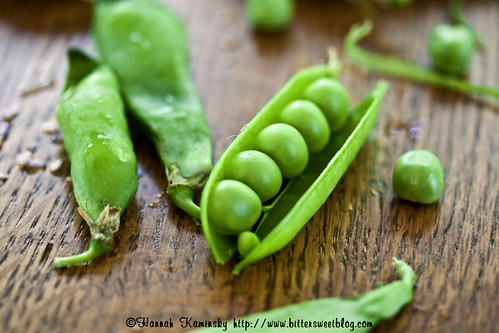
Pardon my silence- The heat, the homework, and the deadlines are all starting to get to me, and I’ve been short on words these days. Hopefully, a couple extra photos might begin to make up for it.


Click for full size

For starters, why don’t you try on this new wallpaper for size? It’s perfectly summery and green, just right for a fresh, new August. Not to mention, I’d much rather sit and shell fresh peas for hours than endure these torturous final exams. Procrastination? You bet! But meditative and quite tasty, at the very least.

The Same, But Different

Classic cakes are fool-proof options to turn to in a moment of need- The standard yellow cake is always agreeable when slathered in a rich and creamy frosting, and that tried-and-true chocolate layer cake has gotten me out of many sticky spots. Always well-received and definitely delicious, I still am reluctant to revisit them, because after so many double or triple batches and repeat performances, they just seem so… Well… Unimaginative. Safe. Dare I say, boring. Happy to take dessert requests from all sides of the family but reluctant to do the same old, same old, it takes a bit of careful creativity to keep myself interested in these projects.

Approaching the issue not from a flavor perspective this time, what’s left that can be played around with? How about the shape?

A deceptively difficult-looking creation, a triangle cake is guaranteed to impress, and maintain the integrity of any flavors desired! The example above is a coconut cake, filled with raspberry preserves and covered with toasted coconut flakes. Just slightly more fuss than a typical layer cake, it was a fun way to add some interest to an otherwise visually dull cake.

To make your very own triangle layer cake, bake any cake you like in two jelly roll pans, and let cool completely. Spread one sheet of cake with jam or filling, and place the second on top. Cut that in half lengthwise, spread more filling or jam on one, and then stack the other half on top of that one. Here’s the trickiest part: Slice that whole thing diagonally, to make two triangles. A visual reference definitely helps here, so check out this helpful tutorial and note that this would be about the fourth picture down after the line.

Stand up the two triangles so that the layers are vertical, spread filling between the tallest layers, and squish the two halves together. Cover the top with frosting like usual (it will hide a multitude of errors, so don’t worry about some less than perfect cuts) and decorate as desired. Present with great fanfare, sit back, and soak in the praise!

(Beware that slices need to be somewhat thick for this type of cake, as you can probably see in the above picture, they do tend to lean/topple over more easily.)

Simplicity in Salad-Form

Unlike some vegans who feel compelled to go against the age-old stereotype that herbivores subsist entirely on twigs and leaves, I’m not afraid to say that I love salads.  Think what you may, but in my eyes, a “salad” can be just about anything, and rarely involves lettuce when I’m in charge. 

Truly, how would this most basic and yet complex term be defined?  Anything chilled and mixed with a dressing?  Think about fruit salad- A sweet twist on the concept that everyone should be quite familiar with.  And then there are bean salads, grain salads, and some bewildering “salads” from down south that involve mayo, pineapple, and bacon. 

They don’t always make sense, they aren’t always healthy, and I certainly don’t endorse them across the board, but it pains me to think that most people still imagine a sad bowl of limp, pale iceberg and maybe some tired old tomato wedges when I say the word “salad.”

On that note, I have come bearing salad, but not one of those obligatory, unwanted side salads that must be choked down in order to get to dessert.  This salad here is comprised mainly of toothsome barley, making it a more wholesome interpretation of pasta salad, in a sense.  Fresh, sweet peas take advantage of the season’s bounty, although frozen and thawed can absolutely work in a pinch. Add in a generous glug of vinegar for a pleasant acidic bite, a handful of chives, and you’re practically done.

Simple almost to the point of brainlessly easy, it’s the perfect quick dish for a hot summer day, or lazy picnic any time.  Just pack it up into little jars, and you’re good to go.  It keeps well, both refrigerated and not, so you don’t have to worry about it spoiling while you go play outside.

Yield: Serves 4 – 6 as a Side Dish

Barley and Fresh Pea Salad

Barley and Fresh Pea Salad

This salad here is comprised mainly of toothsome barley, making it a more wholesome interpretation of pasta salad, in a sense. Fresh, sweet peas take advantage of the season’s bounty, although frozen and thawed can absolutely work in a pinch. Add in a generous glug of vinegar for a pleasant acidic bite, a handful of chives, and you’re practically done.

Prep Time 2 minutes
Total Time 2 minutes

Ingredients

Instructions

  1. A salad like this hardly needs instructions, but here goes: Toss the cooked barley and peas in a bowl, crumble in the “feta,” drizzle in both vinegars and oil. Add the chopped herbs and toss well. Taste, and add salt and pepper as desired. Serve immediately, or cover and chill for up to three days.

Recommended Products

Please note that some of the links above are affiliate links, and at no additional cost to you, I will earn a commission if you decide to make a purchase after clicking through the link. I have experience with all of these companies and I recommend them because they are helpful and useful, not because of the small commissions I make if you decide to buy something through my links.

Nutrition Information:

Yield:

6

Serving Size:

1

Amount Per Serving: Calories: 147Total Fat: 6gSaturated Fat: 2gTrans Fat: 0gUnsaturated Fat: 3gCholesterol: 13mgSodium: 183mgCarbohydrates: 20gFiber: 4gSugar: 2gProtein: 5g

All nutritional information presented within this site are intended for informational purposes only. I am not a certified nutritionist and any nutritional information on BitterSweetBlog.com should only be used as a general guideline. This information is provided as a courtesy and there is no guarantee that the information will be completely accurate. Even though I try to provide accurate nutritional information to the best of my ability, these figures should still be considered estimates.

Soy to the World

Tofu feta has been a mainstay in my own personal recipe repertoire for years now, a mighty tasty marinated tofu creation, packing a vinegary punch and pleasantly herbaceous bite. Feta it is not, and no one would likely confuse the two, but it makes for a highly acceptable substitute in everyday meals. However, for those with access to a serious health food store, “good enough” need not suffice- Sunergia, the little known but growing gourmet tofu makers have an alternative that blows all the others out of the water.

Although they’ve sadly discontinued 2/3 of their feta flavors, the Mediterranean Herb variety still lives on, and is quite a catch to find. Tangy, unmistakably cheesy, and exactly what I remember dairy-based feta to be, it both crumbles and slices beautifully, making it the perfect accent to all sorts of dishes. It’s hard to even think about leaving it out of my salads these days, as that soft, salty piquancy makes it the perfect foil to crisp, fresh veggies. Many lunches these days are accented by a simple combination of diced tomatoes and cucumbers, a handful of parsley and scallion, a touch of olive oil, and a sprinkle of this addictive feta.

It also works nicely over hot dishes too, of course! Pictured above is a quick melange of roasted onions and delicata squash, topped of course with more feta. Just a touch of it seems to perk up any hum-drum dish. If you’re in need of an easy flavor enhancer, look no further- I have yet to find a savory dish that it didn’t brighten up nicely.

Harder to hunt down but even more illustrious, their Bleu Cheese is damned near to-die for. Pungent, sour, and unmistakably umami, it’s hard to describe the flavor, but I can tell you it’s worth tasting for yourself to find out. Like standard bleu (or blue, depending on who you ask,) it may be more of an acquired taste, but die-hard cheese lovers are bound to delight in this cruelty-free alternative. There’s simply nothing else on the market like it.

Of course, the bulk of Sungeria‘s offerings are of regular tofu, but there’s nothing “standard” about them. Flavored with things like pesto, peanut and ginger, portabello, and a whole range of others, these are some of the most flavorful and unique soy products I’ve had the pleasure of discovering. More than just spices and herbs are included, as they throw in tons of crunchy textural enhancers, like sunflower seeds, quinoa, chia seeds, and even pine nuts where appropriate. These are some of the few tofus that anyone could happily eat plain, cold, and completely unadorned. My favorite use for any of the varieties is wrapped up in sushi rolls, adding a whole new dimension to the typical futomaki.

Although my rolling skills could use some work, they also are right at home in the middle of a light and veggie-packed spring roll, the perfect no-cook appetizer or entree for a hot summer’s day.

The real disappointment here, as I’ve alluded to periodically, is that all of the above are very hard to find. You won’t see them at the standard grocery store, and only at a select few Whole Foods’, but should all else fail, you can order them online.