Made with Love

It was the kind of loaf only a baker could love; Emerging from the oven no more attractive than a deflated beach ball, or perhaps a totaled UFO about to make a final descent, it was certainly a sight to behold. Regular loaf pans just weren’t good enough this time around, oh no, it had to be more “special” than that… And boy, was it ever special.

Some devious combination of boredom, curiosity, and creativity drove me to plop a perfectly good yeast dough into a large metal bowl, of all things. Here I though I had just figured out a quick-fix solution to the traditional round bread, no real shaping or braiding required, but my imagined brilliance soon turned to foolishness, as I puzzled over the less than stunning results. Perhaps it could have worked with a smaller bowl, but the fact of the matter was that this was a Hannukah gift, due to be delivered in a matter of hours, thanks to my terrible procrastination. No way to fix it, no time to make another, all I could do was swallow my pride and wrap the yeasty thing up in so much tinsel and curly ribbons that all other ugliness could be overlooked.

Dropped off with little ceremony, obligatory thank you’s exchanged, I was ready to forget all about that bread abortion. Going straight to the computer as soon as I returned home that evening, I sent the recipe to the virtual trash can. What a disappointment of a grandchild I must me, giving that mess to my loving Nana!

Days later, with the fiasco safely out of mind, I learned that the gift had actually been much more of a success than imaginable. I got reports of near raves about that misfit bread, despite its abundant flaws. Looks aren’t everything, huh? So into the digital recycling bin I dove, retrieving the recipe, determined to make a new loaf not nearly so homely in order to blog about it.

And wouldn’t you know, it still came out ugly as sin.

Suspend disbelief for just a moment, and remember that looks aren’t everything. I may not be a fantastic bread braider, or even a borderline competent one, but don’t let that stop you from giving this soft, gently sweetened loaf a shot. Redolent with gentle citrus flavor, the orange essence pairs beautifully with the tart cranberries punctuating each tender bite. A handful of walnuts add just enough toasted flavor and crunch to add depth, rounding out this loaf both in texture and taste. Simple, yes, but made with great care and plenty of love.

Try baking it in a traditional loaf pan if you’d like to simplify things and perhaps end up with a more presentable loaf, but either way, it will still taste just as good.

Yield: Makes 1 Loaf; 10 - 12 Servings

Nana's Cranberry Bread

Nana's Cranberry Bread

Redolent with gentle citrus flavor, the orange essence pairs beautifully with the tart cranberries punctuating each tender bite. A handful of walnuts add just enough toasted flavor and crunch to add depth, rounding out this loaf both in texture and taste.

Prep Time 40 minutes
Cook Time 40 minutes
Additional Time 2 hours 3 seconds
Total Time 3 hours 20 minutes 3 seconds

Ingredients

  • 1 Cup Plain Non-Dairy Milk
  • 1/4 Cup Agave Nectar
  • 1 0.6-Ounce Cube Fresh Yeast, or 1 1/4-Ounce Packet Active Dry Yeast
  • 3 to 3 1/2 Cups White Whole Wheat Flour
  • 2/3 Cup Dried Cranberries
  • 1/2 Cup Toasted, Chopped Walnuts
  • 3/4 Teaspoon Salt
  • 1 Tablespoon Orange Zest
  • 1/2 Teaspoon Ground Cinnamon
  • 1/4 Cup Olive Oil
  • 1 Tablespoon Orange Extract (or 1 Additional Tablespoon Zest)
  • Vegan “Egg” Wash

Instructions

  1. Gently warm the non-dairy milk of your choice up to about room temperature; no hotter than 100 degrees or so, or else you’ll kill the yeast. Add in the agave, and if using dry yeast, sprinkle it over the top. Wait 5 – 10 minutes for it to become active and foamy.
  2. In a large bowl, add the fresh yeast if using, 3 cups of flour, cranberries, walnuts, salt, zest, and cinnamon. Stir to combine, and add in the “milk” mixture, followed by the oil and extract. Mix well, until there are no more dry pockets of flour. If the mixture still seems very wet and sticky, mix in the remaining 1/2 cup of flour. Either use your dough hook attachment to knead the dough for 5 – 10 minutes, or turn it out onto a lightly floured surface and knead by hand for 10 – 15, until the dough is smooth and tacky. Place it in a lightly oiled bowl, cover, and let sit in a warm place for 1 – 1 1/2 hours, until doubled in size.
  3. Once doubled in volume, turn the dough out onto a floured surface, and gently press the air bubbles out with your knuckles. Shape as desired- I don’t think I’m qualified to instruct on the best method for this loaf, but if all else fails, just roll it up into a log and place it in a greased 9 x 5-inch loaf pan. Once shaped, cover and let rest again for 45 – 60 minutes, until not quite doubled in size.
  4. Begin preheating your oven to 375 degrees when the loaf is nearly finished rising for a second time. Carefully brush with your “egg” wash, and bake for 35 – 45 minutes, until golden brown all over and it sounds hollow when tapped on the bottom. Let cool completely before slicing.

Recommended Products

Please note that some of the links above are affiliate links, and at no additional cost to you, I will earn a commission if you decide to make a purchase after clicking through the link. I have experience with all of these companies and I recommend them because they are helpful and useful, not because of the small commissions I make if you decide to buy something through my links.

Nutrition Information:

Yield:

12

Serving Size:

1

Amount Per Serving: Calories: 505Total Fat: 12gSaturated Fat: 2gTrans Fat: 0gUnsaturated Fat: 9gCholesterol: 17mgSodium: 153mgCarbohydrates: 90gFiber: 13gSugar: 11gProtein: 17g

All nutritional information presented within this site are intended for informational purposes only. I am not a certified nutritionist and any nutritional information on BitterSweetBlog.com should only be used as a general guideline. This information is provided as a courtesy and there is no guarantee that the information will be completely accurate. Even though I try to provide accurate nutritional information to the best of my ability, these figures should still be considered estimations.

Pretty Please, with Potatoes on Top?

Long gone are the days of carb-fearing, Atkins-style grain avoidance, but deep within the American psyche, some subconscious resistance still seems to remain. Just mention a meal combining two starches and even the most well-grounded eaters lose their composure, if only for a moment. Rice and corn? Iffy, but passable. Bread and potatoes? Not unless you want the health food police to arrive on your doorstep, handcuffs ready to snap shut over the guilty cook.

It’s perfectly fine for potatoes to be integrated into the bread, but should they separate, it’s a downright culinary crime. Enough of this nonsense, I say.

Have your bread and potatoes together, and eat them, too!

Truly, it’s a damned shame that this traditional “wisdom” has kept the two apart for so long. Rather than serving two individual courses to satisfy the need for both tuber and grain, save yourself the trouble and time with a single side.

Magical things happen when you top a chewy loaf of focaccia with thin slices of golden-fleshed potatoes and a handful of red onions. Crispy and golden brown around the edges but still tender on the inside, the sheath of potatoes creates a topper that sets an otherwise simple flat bread apart from the rest.

There is a secret ingredient, however, kneaded deep within the strands of gluten. Sauerkraut brightens flavors with a much-needed hit of acidity, those tangy notes perfectly in tune with the heartier starches. You might even be able to get away with saying that a slice packs in a serving of vegetables in, too!

Yield: Makes 1 Loaf; 8 - 10 Servings

Sauerkraut and Potato Focaccia

Sauerkraut and Potato Focaccia

Magical things happen when you top a chewy loaf of focaccia with thin slices of golden-fleshed potatoes and a handful of red onions. Crispy and golden brown around the edges but still tender on the inside, the sheath of potatoes creates a topper that sets an otherwise simple flat bread apart from the rest.

Prep Time 30 minutes
Cook Time 30 minutes
Additional Time 9 hours
Total Time 10 hours

Ingredients

Starter:

  • 1/2 Cup All Purpose Flour
  • 1/2 Cup Barley Flour
  • 1/4 Teaspoon Dry Active Yeast
  • 1/2 Cup Water

Dough:

  • 2 Cups All Purpose Flour
  • 1/2 Cup Rye Flour
  • 1/2 Cup Whole Wheat Flour
  • 2 Tablespoons Dark Brown Sugar, Firmly Packed
  • 1 Teaspoon Table Salt
  • 1 3/4 Teaspoons Dry Active Yeast
  • 2 Cups Sauerkraut, Drained
  • 3/4 Cups Water
  • 3 Tablespoons Olive Oil

Topping:

  • 1 Pound Red-Skinned Potatoes
  • 1/2 Medium Red Onion, Thinly Sliced
  • 3 Tablespoons Olive Oil
  • Kosher Salt or Coarse Sea Salt

Instructions

  1. The day or night before hand, mix together all of the ingredients for the starter in a large bowl. Cover with plastic wrap, and leave out in a warm place at least overnight, or for 8 – 24 hours. The longer amount of time is better for developing flavor in the bread, but a minimum of 8 hours with certainly suffice.
  2. Once the starter has sat for as much time as you’re willing to give it, start working on the main dough by combining the flours. Take your drained sauerkraut, squeeze out as much extra liquid as possible, and toss it in the flour to coat. Add this mixture, along with the remaining dough ingredients into the bowl of starter.
  3. Mix thoroughly, and install the bread hook attachment in your stand mixer once the dough has come together. Allow the machine to knead on a slow speed for about 10 minutes. This makes for a fairly loose, sticky dough, so don’t panic if it seems fairly wet.
  4. Transfer the dough into a lightly-grease, clean bowl, cover, and let rise in a warm place for about 1 hour, or until doubled in size.
  5. Preheat your oven to 400 degrees, and lightly grease a 10 x 15-inch jellyroll pan.
  6. Punch down the risen dough gently, and scrape it out onto your prepared pan. Use your finger tips to press it out evenly into the jellyroll shape, leaving nooks and crannies as you go. Set aside while you prepare the topping.
  7. A mandoline will make the process go faster, but you can also use a very sharp knife (and a decent dose of patience). Slice the potatoes to approximately 2 mm in thickness, and then slice the onions just slightly thicker since they will cook faster. Toss both in the olive oil until thoroughly coated, and apply the topping in an even layer over the unbaked focaccia, trying not to overlap slices of potatoes. Sprinkle lightly with salt.
  8. Slide your loaf into the oven, and bake for 25 – 30 minutes, until golden brown all over, the potatoes are fork-tender, and the onions are slightly crispy around the edges. Let cool before slicing.

Recommended Products

Please note that some of the links above are affiliate links, and at no additional cost to you, I will earn a commission if you decide to make a purchase after clicking through the link. I have experience with all of these companies and I recommend them because they are helpful and useful, not because of the small commissions I make if you decide to buy something through my links.

Nutrition Information:

Yield:

10

Serving Size:

1

Amount Per Serving: Calories: 312Total Fat: 9gSaturated Fat: 1gTrans Fat: 0gUnsaturated Fat: 7gCholesterol: 0mgSodium: 559mgCarbohydrates: 52gFiber: 5gSugar: 4gProtein: 7g

All nutritional information presented within this site are intended for informational purposes only. I am not a certified nutritionist and any nutritional information on BitterSweetBlog.com should only be used as a general guideline. This information is provided as a courtesy and there is no guarantee that the information will be completely accurate. Even though I try to provide accurate nutritional information to the best of my ability, these figures should still be considered estimations.

Worth its Weight in Gold [Bricks]

Dark as a solid block of dried molasses and boasting a density that could very well rival lead, vollkornbrot is one serious baked good. As I’ve affectionately nicknamed this loaf “brick bread,” it’s no secret that the texture is entirely different from the standard soft, fluffy American sandwich loaf or crusty French baguette. Not a forgettable filler or bland vehicle for jams or spreads, no sir, this German bread means business. Though easily obtained in most health food stores under the guise of “fitness bread,” shrink-wrapped and alarmingly shelf-stable, those flimsy slices can’t compare to the fresh stuff.

Thickly built on whole grains, and often nuts and seeds, each bite is a whole new textural experience. In fact, the traditional loaves don’t employ the use of any flour at all, employing only cooked wheat, spelt, or rye berries to hold them together. Variably crunchy and chewy, a proper vollkornbrot won’t break teeth, contrary to how some models may appear, but they certainly won’t dissolve into insubstantial fluff on the tongue. Think of each slice as a portable bowl of hot whole grain cereal, perfect for topping with any sweet or savory spread desired. So hearty and filling that just one small piece could power you through a grueling morning’s work, this is solid fuel indeed.

Not convinced yet? Try slicing it thin and assembling some dainty open-faced tea sandwiches. The contrast of that wholesome, grainy melange with light, crunchy cucumbers combines to create a divine little snack. Nothing if not versatile, my preconceived concept of brick bread” has been utterly and totally cast aside thanks to this beauty- Even if my own approach may be far from traditional.

Yield: Makes 1 Loaf; 8 - 10 Slices

Brick Bread (Faux-Vollkornbrot)

Brick Bread (Faux-Vollkornbrot)

Thickly built on whole grains and sprouted beans, each bite is a whole new textural experience. Think of each slice as a portable bowl of hot whole grain cereal, perfect for topping with any sweet or savory spread desired.

Prep Time 15 minutes
Cook Time 45 minutes
Additional Time 1 day 4 hours
Total Time 1 day 5 hours

Ingredients

Starter:

  • 3/4 Cup Hard Red Wheat Berries
  • 3/4 Cup Water
  • 1 Tablespoon Apple Cider Vinegar

Second Addition:

  • 3/4 Cup Steel-Cut Oat Groats
  • 3/4 Cup Water
  • 1 Teaspoon Yeast

Final Dough:

  • 1/3 Cup Sprouted Adzuki Beans
  • 2 Cups White Whole Wheat Flour
  • 1/4 Teaspoon Salt

Instructions

  1. It’s a somewhat long process to make this bread, so above all else, you must have an ample supply of patience on hand! I highly recommend reading the recipe all the way though so you know what kind of process is involved.
  2. First, mix together the ingredients for the starter in a large bowl, cover with plastic wrap, and let sit in a warm place for a full 24 hours.
  3. Once that time has elapsed, add in the “second addition” ingredients, mix well, and let sit for another 3 hours before proceeding.
  4. Finally, you can add in everything called for in the “final dough.” This is where my bread greatly diverges from traditional recipes. I use flour to hold everything together, because it seemed like that mass of grains would never create a solid loaf otherwise. Mix well, and kneed for 10 – 15 minutes to activate the gluten. Once smooth and elastic, roll the dough into a log and gently place it into a lightly greased 8 x 4-inch loaf pan. Let rise for about 1 hour before preheating the oven to 375 degrees.
  5. Bake for about 45 minutes, until the crust is evenly amber brown. If it seems to be browning too quickly, you can tent a piece of foil over the top of the loaf pan. Let cool on a wire rack completely before slicing.

Recommended Products

Please note that some of the links above are affiliate links, and at no additional cost to you, I will earn a commission if you decide to make a purchase after clicking through the link. I have experience with all of these companies and I recommend them because they are helpful and useful, not because of the small commissions I make if you decide to buy something through my links.

Nutrition Information:

Yield:

10

Serving Size:

1

Amount Per Serving: Calories: 162Total Fat: 1gSaturated Fat: 0gTrans Fat: 0gUnsaturated Fat: 1gCholesterol: 0mgSodium: 57mgCarbohydrates: 34gFiber: 6gSugar: 1gProtein: 7g

All nutritional information presented within this site are intended for informational purposes only. I am not a certified nutritionist and any nutritional information on BitterSweetBlog.com should only be used as a general guideline. This information is provided as a courtesy and there is no guarantee that the information will be completely accurate. Even though I try to provide accurate nutritional information to the best of my ability, these figures should still be considered estimations.


Rainy Day Baking

Propelled out of bed by the light of a new day, it’s the sunshine that pushes me to my feet and sends them racing down the stairs, seemingly of their own power.  No matter how little sleep occurred that previous night, hardly a minute past sunrise will elapse before I bolt awake, feeling the intense urge to start whittling down my lengthy to-do list.  Morning without sunshine are like rhubarb without sugar; bitter and disappointing.

It’s not unheard of for me to sleep right up until noon if the sun fails to show, as if I forgot to set my internal alarm clock. Cloudiness goes hand in hand with mental fogginess, so it’s always safest to avoid heavy intellectual lifting on such occasions. However, there is one reason why I still have a soft spot for the otherwise unlovable rainy days of summer- That warm, humid air that is otherwise my eternal foe (at least as far as keeping anything less than a frizzy afro goes) creates the perfect environment for raising yeast. Thus, rainy days have become synonymous with yeast bread for me.

With a rainy stretch predicted recently, there seemed like no better time than to pour through my files of bread ideas and pick out something new. Feeling a little bit short on desserts lately, I leaned towards the sweeter side of the kitchen, and turned a classic spring cake into a sturdy but tender yeasted loaf. Speckled with walnuts, raisins, and of course orange flecks of carrot, this new take on carrot cake is certainly a mouthful, but it’s not at all hard to swallow. One might even feel slightly virtuous selecting a slice or two for breakfast, since you’re getting a nice serving of carrot, right?

Since no good carrot cake is ever plated without that signature cream cheese frosting, I could hardly leave my bread without the same. Instead of smearing it on the outside, however, a lightly sweetened “cream cheese” swirl spirals around the center, making for a more portable, clean-cut version of the original as well.

Toasted lightly to crisp up the edges and make the swirl slightly gooey, it may just provide sunshine enough to get me out of bed early on the next rainy set of days.

Yield: Makes 2 Loaves

Yeasted Carrot Cake Bread

Yeasted Carrot Cake Bread

Speckled with walnuts, raisins, and of course orange flecks of carrot, this new take on carrot cake is certainly a mouthful, but it’s not at all hard to swallow. One might even feel slightly virtuous selecting a slice or two for breakfast, since you’re getting a nice serving of carrot, right?

Prep Time 30 minutes
Cook Time 35 minutes
Additional Time 2 hours 30 minutes
Total Time 3 hours 35 minutes

Ingredients

Carrot Cake Dough:

  • 1 Cup Plain Non-Dairy Milk
  • 2/3 Cup Dark Brown Sugar, Firmly Packed
  • 2 1/4 Teaspoons (1/4-Ounce Package) Active Dry Yeast
  • 4 – 6 Cups All Purpose Flour
  • 1 Tablespoon Ground Cinnamon
  • 2 Teaspoons Ground Ginger
  • 1/4 Teaspoon Ground Nutmeg
  • 3 Cups Shredded Carrot
  • 1/2 Cup Chopped Walnuts
  • 1/2 Cup Raisins
  • 1 Tablespoon Flax Seeds, Ground
  • 1/2 Teaspoon Salt
  • 1/3 Cup Olive Oil
  • 1 Teaspoon Vanilla Extract

Cream Cheese Filling:

  • 1 8-Ounce Package Vegan Cream Cheese
  • 1/3 Cup Cornstarch
  • 3/4 Cup Granulated Sugar
  • 1/2 Teaspoon Vanilla Extract

Instructions

    1. Starting with the dough, begin by warming your milk of choices for just a minute or two in the microwave, until it reaches between 105 – 115°F. No more, or else you’ll kill the yeast. Stir in the brown sugar, and sprinkle in the yeast and let sit for about 5 minutes, until it becomes bubbly and alive.
    2. Meanwhile, combine the first 4 cups of flour, spices, raisins, walnuts, carrots, ground flax, and salt in the bowl of your stand mixer. Mix lightly just to distribute all of the ingredients evenly and coat the carrot shreds with flour.
    3. Pour in the proofed yeast mixture, along with the oil and vanilla, and start mixing on a low speed, so as not to kick any flour out of the bowl. Once incorporated, switch over to the dough hook, add in 1 more cup of flour, and allow the mixer to begin kneading the dough.
    4. After about 5 minutes of mixing, assess the texture; You’re looking for it to be tacky and elastic, not wet or sticky. You may need to add up to another cup of flour, depending on the consistency.
    5. Continue working the dough with the dough hook for 5 – 10 more minutes. Scrape the dough out onto a lightly floured surface, and kneed by hand briefly, for just 5 minutes or so, before placing it into a lightly oiled bowl. Cover loosely with a cloth or piece of plastic wrap, and let sit in a warm place for about 1 1/2 hours, until doubled in volume.
    6. Once risen, lightly grease two 8 x 4-inch loaf pans, and set aside.
    7. Gently punch down the dough with your knuckles, cut it into two pieces, and on a well-floured surface, take one piece and roll it out into a rectangle. Be sure to keep the two short sides no longer than 8 inches so that it will fit in the pan, but roll it out lengthwise as far as possible- The longer the dough, the more impressive your spiral will be in the finished loaf.
    8. To make the cream cheese swirl, simply beat together the cream cheese, cornstarch, sugar, and vanilla until smooth. Take half of the mixture and smear it evenly over your rolled out dough, leaving about an inch of one short end clear. You may want to spread a slightly thinner layer near the other edges, to prevent it from dripping out when you move the dough. Starting with the short end that’s fully covered, roll the dough up as tightly as possible without squeezing out the filling. Pinch the end to the main body of the loaf to seal, and quickly but carefully transfer the whole thing to one of your waiting loaf pans, ends slightly folded under and seam-side down. Repeat with the other piece of dough.
    9. Let the breads rise for another hour or so, until about doubled or just peeking out above the edge of the pans, and then pop it them a 375 degree preheated oven, for about 26 – 36 minutes. It should be golden brown on top, and when removed from the pan, it will sound hollow when tapped. (Yes, you can cool it, tap it, and then toss it back in the oven if it doesn’t sound right.)
    10. Let cool completely before slicing.

Recommended Products

Please note that some of the links above are affiliate links, and at no additional cost to you, I will earn a commission if you decide to make a purchase after clicking through the link. I have experience with all of these companies and I recommend them because they are helpful and useful, not because of the small commissions I make if you decide to buy something through my links.

Nutrition Information:

Yield:

24

Serving Size:

1

Amount Per Serving: Calories: 601Total Fat: 9gSaturated Fat: 2gTrans Fat: 0gUnsaturated Fat: 6gCholesterol: 1mgSodium: 71mgCarbohydrates: 114gFiber: 4gSugar: 15gProtein: 15g

All nutritional information presented within this site are intended for informational purposes only. I am not a certified nutritionist and any nutritional information on BitterSweetBlog.com should only be used as a general guideline. This information is provided as a courtesy and there is no guarantee that the information will be completely accurate. Even though I try to provide accurate nutritional information to the best of my ability, these figures should still be considered estimates.

Falling for Pumpkin

As if suddenly freed from the restraints of summer’s final days, autumn’s official first day saw me clamoring back into the kitchen, scheming up new ways to reintroduce my favorite orange gourd once back into my diet. Pumpkin is just one of those endlessly versatile ingredients that can be prepared any way you can imagine- Be it sweet or savory, salty or sour, crunchy or creamy- And still never get old. It may be hard not to rely on this multifaceted squash for cooking inspiration in the days to come, being such a perfect flavor for the fresh season and all, but I’m not holding back today, not when the leaves are turning and the air itself carries the essence of fall!

If there were anything more cozy than a pumpkin dish for an unexpectedly chilly day, it would definitely be a pumpkin bread. But this time, my sweet tooth was no where to be found, relenting to the otherwise quiet desire for something a bit more savory. No need to compromise though, a yeasted pumpkin bread that leaned more on salt than sugar fits the bill just fine.

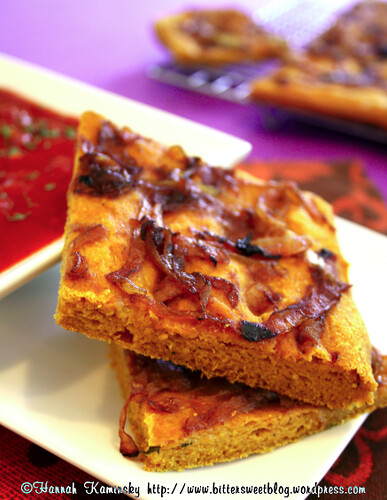
Lightly spiced with a dash of nutmeg and a pinch of sage, this bright orange bread is in truth an attempt at focaccia gone awry, but I prefer to think of it merely as a flat bread, better suited to accompany a nice warm soup anyway, if you ask me. While it would be delicious by itself, the topping of soft caramelized onions is what makes this otherwise simple bread stand out, putting it heads and shoulders above any other plain pumpkin loaf. There is one problem with it though- It seems to magically disappear if you leave it on the counter for a day!

Yield: Makes 12 - 16 Servings

Pumpkin Flat Bread with Caramelized Onions

Pumpkin Flat Bread with Caramelized Onions

Lightly spiced with a dash of nutmeg and a pinch of sage, this bright orange bread is topped with caramelized onions for a sweet and savory finish.

Prep Time 25 minutes
Cook Time 1 hour 45 minutes
Additional Time 9 hours
Total Time 11 hours 10 minutes

Ingredients

Pumpkin Focaccia:

  • 3/4 Cup Warm Water
  • 1 Teaspoon Agave Nectar
  • 1 0.6-Ounce Cube Fresh Yeast or 2 1/4 Teaspoons Active Dry Yeast
  • 3 Cups White Whole Wheat Flour
  • 1 Teaspoon Salt
  • 1/4 Teaspoon Ground Nutmeg
  • 1/2 Teaspoon Chopped Dried Sage
  • 2 Tablespoons Olive Oil
  • 1 15-Ounce Can Pumpkin Puree

Caramelized Onions:

  • 1 Tablespoon Olive Oil
  • 3 Medium Yellow Onions, Thinly Sliced
  • Pinch Salt
  • Pinch Pepper
  • Pinch Baking Soda

Instructions

  1. In a small bowl, stir together the warm water and agave, and crumble in the fresh yeast. Stir to combine, and let sit for 5 minutes.
  2. Sift the flour into your stand mixer, along with the salt, nutmeg, and sage, and mix briefly before pouring in the yeast mixture. Install the dough hook attachment before proceeding, as things may get a bit sticky from here on in. Add in the pumpkin puree and olive oil, and let the mixer slowly incorporate these wet ingredients. Scrape down the sides of the bowl as necessary, until there are no remaining patches of dry flour. Continue running the machine, allowing it to kneed the dough for about 10 minutes. It should still be rather wet and sticky, but much smoother than before. Transfer the dough into a lightly greased bowl, cover with plastic wrap, and let it rest in the refrigerator overnight, or about 8 – 10 hours.
  3. In the morning, take the bowl of out the fridge to let it come to room temperature while you deal with the topping. Peel and cut the onions in half, from pole to pole, and slice them thinly. Place a pan over moderate heat and pour in the oil. Add the onions, followed by a pinch of both salt and pepper, and just the tiniest dash of baking soda. (This helps the caramelizing process move a bit faster- You can leave it out if you’d prefer, but you shouldn’t taste it in the end.) Stirring every couple of minutes, cook the onions until the reach a light brown hue, but be careful not to take them too dark, as they’ll continue to cook in the oven. Remove the pan from the heat and let cool.
  4. Grease a 15 x 10-inch jelly roll pan and set aside.
  5. Turn the dough out onto a lightly floured surface, and use your fingers to press it out into more or less of a rectangle. Fold it over itself like a letter, press firmly, and turn it. Repeat this a few times, until the surface seems smooth. Transfer the rectangle into your prepared pan, and once again use your fingers to coax it out into the corners. It may seem like not enough dough, but it will cover the pan with a bit of persuasion. Let rise at room temperature for about one hour.
  6. Meanwhile, begin preheating your oven to 375 degrees. When the dough seems almost ready, poke it like you would a focaccia to give it a slightly bumpy-looking surface. Spoon the onions evenly over the top.
  7. Bake for 35 – 45 minutes or until the loaf is nicely browned on the bottom (remove the bread from the oven and use oven mits to peek underneath, being very careful not to burn yourself of course!) Depending on how dark you cooked you oven, you may wish to tent the loaf with aluminum foil after about 20 minutes to prevent them from burning. Let cool on a wire rack.

Recommended Products

Please note that some of the links above are affiliate links, and at no additional cost to you, I will earn a commission if you decide to make a purchase after clicking through the link. I have experience with all of these companies and I recommend them because they are helpful and useful, not because of the small commissions I make if you decide to buy something through my links.

Nutrition Information:

Yield:

16

Serving Size:

1

Amount Per Serving: Calories: 128Total Fat: 3gSaturated Fat: 1gTrans Fat: 0gUnsaturated Fat: 3gCholesterol: 0mgSodium: 150mgCarbohydrates: 22gFiber: 4gSugar: 2gProtein: 5g

All nutritional information presented within this site are intended for informational purposes only. I am not a certified nutritionist and any nutritional information on BitterSweetBlog.com should only be used as a general guideline. This information is provided as a courtesy and there is no guarantee that the information will be completely accurate. Even though I try to provide accurate nutritional information to the best of my ability, these figures should still be considered estimations.

Growing like Weeds

Despite the common complaints echoing through the blogosphere about planting too much zucchini, and consequently eating far too many meals based around the green summer squash, it sounds like the best problem a gardener could have. Impossible to imagine from my barren plot of rocky earth, an overabundance, or even modest yield of anything edible would be a welcome challenge to tackle. So while the next foodie is grumbling about their 5th zucchini bread of the season, and wondering who else they could pawn this next loaf off on, I find my appetite for this humble staple growing by the day, just like the vegetables in question.

Not until recently had I even tried zucchini bread, much less considered it as a baked good so fundamental to summer loving. Egged on by my mom’s skepticism about savory vegetables baked into a sweet quick bread, I was convinced I would prove her wrong, throwing in spices, brown sugar, and chocolate to really dress up that otherwise ordinary loaf.

No doubt, this was what excess zucchini was made for, and each of the dozen carefully cut slices disappeared in no time. But without my own glut of summer squash, this revelation was quickly forgotten, and another year passed before the concept flickered into my head. Again, my mother made faces at the mention of such a bread, her experience lost in the passage of time as well.

So it was time to step it up yet again. Forget that plain old zucchini bread. Try, zucchini babka.

Traditionally reserved for holidays, this rich, yeasted bread is the perfect vehicle for some of those excess zucchinis.  Really, you’d be kidding yourself if you approached this as a “healthier” treat thanks to the vegetables, as it could very well be more decadent than that ubiquitous carrot cake piled high with cream cheese frosting.   Don’t let that stop you from having a thick slice for breakfast though; if you can call a cupcake without frosting a muffin, you can easily get away with pretending that this cake in bread’s clothing is a reasonable choice to start the morning.  Your taste buds will certainly thank you.

Even if you’re not “burdened” with extra zucchini, this one is worth picking up an extra squash or two at the market for.

Yield: Makes 1 Large Loaf; 10 - 12 Slices

Zucchini Babka

Zucchini Babka

Traditionally reserved for holidays, this rich, yeasted bread is the perfect vehicle for some of those excess zucchinis.  Really, you'd be kidding yourself if you approached this as a "healthier" treat thanks to the vegetables, as it could very well be more decadent than that ubiquitous carrot cake piled high with cream cheese frosting.   Don't let that stop you from having a thick slice for breakfast though; if you can call a cupcake without frosting a muffin, you can easily get away with pretending that this cake in bread's clothing is a reasonable choice to start the morning.  Your taste buds will certainly thank you.

Prep Time 30 minutes
Cook Time 50 minutes
Additional Time 2 hours
Total Time 3 hours 20 minutes

Ingredients

Zucchini Dough:

  • 1 Cup Plain Non-Dairy Milk
  • 1/2 Cup Granulated Sugar
  • 1 1/4-Ounce Package Active Dry Yeast
  • 4 – 6 Cups All Purpose Flour
  • 2 Cups Shredded Zucchini, Squeezed and Drained of Excess Liquid
  • 1 Tablespoon Chia Seeds, Ground
  • 1 Teaspoon Vanilla Extract
  • 1/2 Teaspoon Salt
  • 1/2 Cup Vegan Butter, Cut into Pieces and at Room Temperature

Chocolate-Cinnamon Filling:

  • 3 Tablespoons Melted Vegan Butter, Divided
  • 6 Ounces Semi-Sweet Chocolate, Chopped Finely
  • 1 Teaspoon Ground Cinnamon
  • 1/4 Cup Granulated Sugar

Instructions

  1. To make the dough, first warm the non-dairy milk for just a minute or two in the microwave, until it reaches between 105 – 115°F. Be careful, because any hotter and you’ll kill the yeast! Stir in the sugar, and sprinkle the yeast in and let it sit for about 5 minutes, until bubbly and active. Transfer this mixture into your stand mixer, along with 3 cups of the flour, the chia seeds, zucchini, vanilla, and salt. Begin mixing on low, so as not to kick any flour out of the bowl, and continue until the dry ingredients have become mostly incorporated. Switch over to the dough hook, add in 1 more cup of flour, and allow the mixer to begin kneading the dough.
  2. Once the dough is smooth, add in 1 – 2 more cups of flour, depending on how sticky it is. You want it to be tacky and elastic, but not wet and gooey. Continue working the dough with the dough hook while slowly dropping in pieces of vegan butter, one at a time, waiting until the previous piece has been incorporated before adding the next. It should become very shiny and soft. After all of the butter has been used, let the stand mixer keep kneading for 5 – 10 more minutes. Scrape the dough out into an oiled bowl, cover loosely with a cloth or piece of plastic wrap, and let sit in a warm place for about 1 1/2 hours, until doubled in volume.
  3. Scrape dough into a lightly oiled bowl and cover bowl with plastic wrap. Let dough rise in a draft-free place at warm room temperature until doubled in bulk, 1 1/2 to 2 hours.
  4. To assemble your babka, first lightly grease a 9 x 5 inch loaf pan, and set aside.
  5. Punch down the dough with your knuckles, and on a well-floured surface, roll it out into a rectangle. Be sure to keep the two short sides no longer than 9 – 11 inches so that it will fit in the pan, but roll it out lengthwise as far as possible- The longer the dough, the more spirals you will get in the finished bread.
  6. Brush your rectangle with 2 tablespoons of the melted butter, leaving 1/2 inch of one of the long sides clear. Mix together the chopped chocolate, cinnamon, and sugar in a small bowl, and sprinkle it evenly over the dough. Press the filling in gently with your hands. Starting with the long edge that is completely covered, roll up the dough as tightly as possible, but don’t be aggressive, as it’s a fairly delicate dough.
  7. Once you get a very long tube, arrange it with the two ends next to each other, like a squashed horse shoe. Twist the two sides together, and press the ends beneath the mass of dough, and carefully fit it into the pan. If your dough is too large to fit comfortably, you may need to fold more of the ends underneath. Brush the top of the dough with the remaining tablespoon of butter.
  8. Don’t panic- This is a VERY large loaf! It will seem way too big for the pan, but don’t worry, it will simply be very impressive when finished.
  9. Let the bread rise for another hour or so, until just about doubled, and then pop it into a 350 degree preheated oven, for about 40 – 50 minutes. It should be golden brown on top, and when removed from the pan, it will sound hollow when tapped. (Yes, you can cool it, tap it, and then toss it back in the oven if it doesn’t sound right.)
  10. Let cool completely before slicing.

Recommended Products

Please note that some of the links above are affiliate links, and at no additional cost to you, I will earn a commission if you decide to make a purchase after clicking through the link. I have experience with all of these companies and I recommend them because they are helpful and useful, not because of the small commissions I make if you decide to buy something through my links.

Nutrition Information:

Yield:

12

Serving Size:

1

Amount Per Serving: Calories: 1151Total Fat: 18gSaturated Fat: 5gTrans Fat: 2gUnsaturated Fat: 12gCholesterol: 2mgSodium: 107mgCarbohydrates: 216gFiber: 9gSugar: 23gProtein: 29g

All nutritional information presented within this site are intended for informational purposes only. I am not a certified nutritionist and any nutritional information on BitterSweetBlog.com should only be used as a general guideline. This information is provided as a courtesy and there is no guarantee that the information will be completely accurate. Even though I try to provide accurate nutritional information to the best of my ability, these figures should still be considered estimations.