
Liquid Gold

Often likened to gemstones and other rare treasures, quite frankly, the rocks pale in comparison to argan oil. Incredibly rare, this so-called “liquid gold” is produced only in Morocco from the kernel of a dying breed of tree. Extracting the oil itself is a painstaking process, and thus the cost is near astronomical. Used for culinary, cosmetic, and medicinal purposes, rumored health benefits reach far and wide across any proposed usage. Whether it’s eaten, rubbed into the skin, or applied to the hair, it would seem as though anything it touches is magically improved and given a certain glow. Deciphering where the hype ends and the health benefits begin is hard to say, but there is definite merit in the claims; truth be told, it’s long been my hair care secret. Few chemical combinations have been able to tame my curly locks, but this simple oil has brought shine and smoothness to my otherwise frizzy mop of a mane. Of course, the argan oil I use in my hair isn’t pure, but cut with a number of other fillers and fragrances to bring down costs. Nothing you’d want to put in your mouth, that’s for sure.

Culinary-grade oil produced by The Argan Tree, on the other hand, is a luxurious indulgence for the palate. Setting aside the proposed nutritional perks, argan oil is worth splurging on at least once in a blue moon for the sublime flavor. Richly scented of roasted nuts, reminiscent of toasted sesame oil, it’s incredibly aromatic for such an unassuming pale yellow nectar. Deep, woodsy roasted notes prevail, though the effect is quite mild and smooth overall. Finishing with a subtle sweetness and absolutely no bitterness or astringent qualities to speak of, the centuries-long love affair with argan oil becomes easy to understand with a single taste. Surprisingly light, it doesn’t coat the palate, but dissipates quickly; a fleeting delight to chase after with another oil-imbued morsel.

An ingredient of such pedigree must be treated with respect, and for the most part allowed to shine unhindered. Applied to salads, soups, or breads unadorned (and never cooked!), the best way to enjoy argan oil is by pairing it with simple but delicious fresh fruits and veggies. Now that heirloom tomatoes are back in season, I simply couldn’t resist dressing them up in a lush argan coat.


Plate provided by Steelite

No recipes required. It would be a shame to cover up or modify such an extraordinary oil.

Have you ever tried argan oil? How do you like to serve it?
When Food Bites Back

Eggplant, my dear, you are one cruel mistress. I’ve professed my love to you time and again, but nothing will tame your harsh bite; the most delicate preparations or careful peeling does little to lessen the fire. I’ve come to realize that it’s honestly not you, eggplant darling, but me. The burning sensation that inflames my whole mouth, throat, and stomach, comparable to an intense and wide-spread heartburn, is the sign of an intolerance. It also reminds me of those who suffer from reflux conditions like GERD or LPR, where stomach acids cause discomfort in the esophagus.

Given the prevalence of food allergies, and allergies in general, I’ve been incredibly lucky. I can eat my gluten with gusto, and relish my peanut butter-smeared apple slices, unlike many Americans these days. Complaining about something so mild as a slight discomfort when eating eggplant feels incredibly petty in comparison. It’s nothing life-threatening, does no permanent damage, but only removes a beloved vegetable from my diet. Admitting that though still stings a bit, too. Sometimes the pain will be worth it, and I’ll dive into that plate of spicy, garlicky, and meltingly tender Chinese eggplant anyway, but now that I’ve given it a name and told the internet about it, I may not be able to do so as easily anymore.

Not one to shy away from a challenge, once the brief mourning period passed I set to work devising ways to work around that purple nightshade. Closely linked in my mind, for their mild flesh and similar squash lineage, zucchini has now started vying for the title of “most popular vegetable” in my fridge these days.


Dishes provided by Steelite

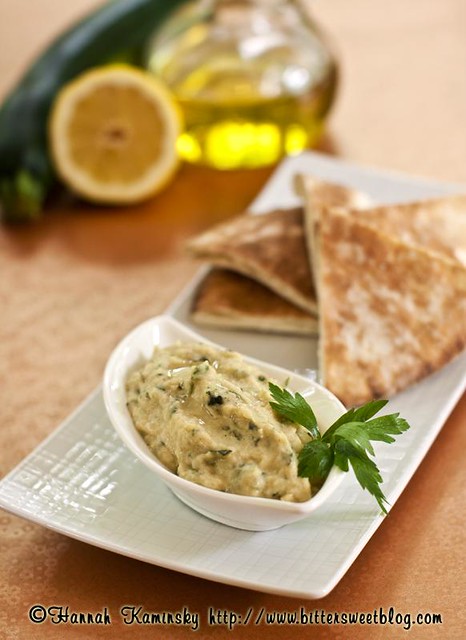
Baba ganoush was my first introduction to eggplant, before I even knew what was in the mellow, smoky dip, and is still a top pick. Given that the squash would be mostly ground up, it seemed like a good test to see how my new zucchini friends would fare, replacing that original love. Anticipating from the get-go that nothing would ever replace those eggplant, or even come close, I was startled at my first taste. The simple addition of smoked salt helped to pick up the deeper, woodsier notes that the delicate flesh couldn’t replicate alone, and it made all the difference. With a flavor far closer that I could have hoped to come to the original inspiration, this mild but wonderfully savory, lightly roasted taste sensation gives me hope for life without eggplants.

I’ll admit to secretly holding out hope that the intolerance is just a passing phase, but until there’s actual evidence of that, I think I’ll get along just fine with my glorious, green zucchinis instead.

Yield: Makes 1 1/2 – 2 Cups

Zuke-anoush (Zucchini Baba Ganoush)

Zuke-anoush (Zucchini Baba Ganoush)

For anyone avoiding nightshades, this eggplant-free take on baba ganoush is for you. Lightly roasted zucchini is blended with smoked salt and tahini for an incredibly accurate take on the original inspiration.

Prep Time 15 minutes
Cook Time 30 minutes
Total Time 45 minutes

Ingredients

  • 1 1/2 Pounds Zucchini (About 2 Large or 3 Medium)
  • 6 – 8 Garlic Cloves, Separated From the Head but Not Peeled
  • 1 Tablespoon Olive Oil, Plus Additional to Garnish
  • Pinch [Table] Salt and Black Pepper
  • 3 Tablespoons Sesame Tahini
  • 2 Tablespoons Lemon Juice
  • 1/4 Teaspoon Ground Cumin
  • 1/4 Teaspoon Fine Grain Smoked Salt

Instructions

  1. Preheat your oven to 400 degrees, and line a baking sheet with aluminum foil.
  2. Slice the zucchini into 1/4-inch thick rounds, and toss them in the oil, salt and pepper until evenly coated. Lay them out in one even layer, with no pieces overlapping, on your prepared baking sheet. Place the whole cloves of garlic grouped in the center of the sheet so that they don’t burn. Roast for 30 minutes, until the zucchini are nicely browned. Let cool.
  3. Once the vegetables have come to room temperature, peel the garlic cloves, and toss them into your food processor along with the roasted zucchini. Add in the tahini, lemon juice, cumin, and smoked salt. Pulse to combine, until you create a rough and chunky sort of paste. You don’t want it to be smooth, so err on the side of less processed if you’re not certain. It should only take about 5 – 10 one-second pulses, depending on your machine.
  4. Transfer the finished dip into an air-tight container, and ideally let it cure in the fridge for at least 8 hours or overnight before serving. It’s delicious eaten immediately, but the flavors do meld and improve with a bit of time. Serve with an additional drizzle of olive oil over the top, if desired.

Nutrition Information:

Yield:

16

Serving Size:

1

Amount Per Serving: Calories: 37Total Fat: 1gSaturated Fat: 0gTrans Fat: 0gUnsaturated Fat: 1gCholesterol: 0mgSodium: 13mgCarbohydrates: 6gFiber: 1gSugar: 1gProtein: 1g

Oldie but Goodie

Recipes come and go as the years pass, but coconuts are forever. At least, the latest coconut craze seems like its a trend that could last until the end of eternity. Looking back on older posts where I declared 2009 the “year of the coconut,” I have to wonder what that made 2010, and now 2011, too, because that tropical fruit was still king of the health food castle last time I checked.

Not everything is the same since that original review though. Branding has become more dangerous, a fine line between enticing and deceiving customer, and wording on packages more careful. You’ll no longer find coconut kefir in the marketplace, but “cultured coconut beverages” instead. Same thing, new name. Perhaps it was deemed a more accurate description of the opaque bottles’ contents, or just a more approachable label for those intimidated by fermented edibles, but I can’t say for sure. All I do know is that it can still make a mean stack of pancakes.

Though these pancakes originally showed up around the same time as that review post, I never shared the recipe. Unsurprisingly, the no-bake “kefir” cheesecake stole the spotlight at the time. It’s a damn shame, because these are some of the fluffiest pancakes to escape my frying pan, and the added nuance of subtle coconut flavor adds an irresistible element of salty, savory goodness. Their naturally tropical flavor makes them the perfect fit for a summer breakfast or brunch, but still every bit as tasty served up in any season.

If you can’t find the cultured coconut beverage in your area, you could very happily substitute 1 cup of plain coconut yogurt plus 1/2 cup of plain coconut beverage (or any non-dairy milk) instead. To really bump up the coconut flavor if you want more than a gentle hint, add a splash of coconut extract.

Yield: 3 - 4 Servings

Fluffy Coconut Pancakes

Fluffy Coconut Pancakes

Light and fluffy pancakes with a subtle coconut flavor, adding an irresistible element of salty, savory goodness. Their naturally tropical flavor makes them the perfect fit for a summer breakfast or brunch, but still every bit as tasty served up in any season.

Ingredients

  • 1 Cup All Purpose Flour
  • 1/2 Cup Coconut Flour
  • 1 Tablespoon Granulated Sugar
  • 2 Teaspoons Baking Powder
  • Pinch Salt
  • 1 1/2 Cups Cultured Coconut Beverage or 1 Cup Unsweetened Coconut Yogurt + 1/2 Cup Plain Coconut Beverage
  • 1/3 Cup Water
  • 1 Tablespoon Olive Oil
  • 1/2 Teaspoon Vanilla Extract

Instructions

  1. Like most pancakes, these couldn’t be easier to whip up. Just combine both flours, sugar, baking powder, and salt in a large bowl, and whisk to distribute all of the dry goods. Separately, stir together the coconut beverage, water, oil, and vanilla, and then pour these liquids into the large bowl as well. Whisk just to combine; a few lumps are just fine here, so don’t over-mix.
  2. Place a large (preferably non-stick) skillet over medium heat, and very lightly grease. Use about 3 – 4 tablespoons of batter for each pancake, and cook on the first side for 4 – 6 minutes, until bubbles burst on the top and they feel sturdy enough to flip.
  3. Flip, and cook on the second side for an additional 2 – 5 minutes, until golden and fully cooked through in the center.
  4. Serve immediately, or keep warm in an oven preheated on the “warm” setting.

Notes

For a treat that combines the best of breakfast and dessert, try a short stack of these babies with a generous scoop of coconut ice cream on top!

Nutrition Information:

Yield:

4

Serving Size:

1

Amount Per Serving: Calories: 519Total Fat: 30gSaturated Fat: 24gTrans Fat: 0gUnsaturated Fat: 5gCholesterol: 3mgSodium: 437mgCarbohydrates: 58gFiber: 9gSugar: 23gProtein: 8g

Christmas in July

Sleigh bells are most certainly not ringing on this sweltering day, but in a summer state of mind, the ice cream truck’s cheerful jingle could happily suffice. Christmas in July is a phenomena that has not yet truly caught on in the US, typically reserved as a poor excuse to go on shopping sprees or drink a few too many cocktails by the beach. The lack of decent holidays through the hottest months of the year has me searching high and low for new events to celebrate, anything to shake up the monotony of one hot and busy day after another, so I say it’s high time we start getting into the spirit. Build a “snowman” on out of sand, string lights onto a palm tree, make gingerbread baked inside oranges over the campfire! If you can find an indoor rink, now is the best time to go ice skating, too; shockingly empty of other skaters, it’s the perfect chilly respite from a 100-degree afternoon.

Better yet, serve up some peppermint-mocha whoopie pies.

Though they do require quick use of the oven, the sweat will be worthwhile, since the end results are satisfyingly sweet and cooling. A spinoff on my Peppermint Mocha Trifles from Vegan Desserts, this hand-held version is ideal for speedy baking and on-the-go eating. Just make a half batch of everything, adding 3/4 cup of flour to the cake portion. Instead of pouring the cake batter into a baking dish, scoop it out onto a silpat-lined baking sheet, using a small cookie scoop for consistent shapes. Bake for 10 – 15 minutes at 350 degrees, until just lightly browned around the edges, and let cool completely. Spread your chilled chocolate custard between two cookies, and then roll the edges in crushes candy canes. Voila, a miniature, portable trifle- With a touch of summery Christmas spirit!

This will make you approximately 36 individual cookies, and thus 18 finished whoopie pies. Store the cake-like sandwiches in the fridge for maximum refreshment, or in the freezer to make mock-ice cream sandwiches. Be sure to eat them quickly once the peppermint candies have been added- As evidence by my photo, the can melt quickly due to the moisture and heat. Plus, I can’t imagine anyone being able to resist chowing down for that long!

Picture This

Change comes slowly, incrementally building while no one’s looking, until suddenly the vast difference can no longer be ignored. That fact had never been more clear while going over the raw manuscript of Vegan Desserts, and giving the photos their final assessment. Though all of the recipes already had photos taken about a year ago, some of them showed their age, and in the most unflattering way. Blurry focus, poor lighting, bizarre styling decisions plagued almost all; it was hard to believe that these images might have made it to print previously. Pictures speak louder than words, however, so I’ll let you see for yourself…

No decisions were easy here, and the originals weren’t bad enough for me to delete altogether, but it’s a curious thing to see the contrast between two (or three) photos of the same thing, taken with a good bit of time between them.  (The following photos are arranged with the first attempt(s) on the left, the final, printed photos on the right.)

This one was a particularly tough photo to ultimately reject, because the cute-factor is a whole new category not even touched in most food photos. Perhaps for a reason, though. Isis was so excited about her treat, she wouldn’t stay still, and thus is one blur of a puppy on film. Yes, my dad had to assist on this shot, both in holding the biscuit, and holding Isis back so that she didn’t wolf down the biscuit before I could snap a shot! Also note that the original version of the Canine Cookies were carob-coated, but that ended up smearing on the rug beautifully, so I switched to chips mixed in.

The Grasshopper Cake was really something else; a slightly intimidating multi-layer cake that could feed an army for a month. Or at least it felt that way, when I found myself redoing the photo not once, but twice to make three separate attempts altogether. Beginning life as a 4-layer, square cake, it became clear after that first failed shot that it was simply too much cake for any sensible person to bake up at once. Then, somehow, it turned neon-green on film, and looked downright radioactive. The final photo that went to print still could use some work in the lighting department, but at least the frosting doesn’t look like I mixed in day-glow wall paint as an ingredient.

My blood oranges may not have been such a luscious shade of crimson red the second time around, but the effect of seeing them arranged on the whole Blood Orange Upside-Down Cake was worth the effort of a full redo. Simply from an instructional view, it made more sense to show how the orange slices were laid out on the cake, to make it easier to replicate for the casual recipe reader. Plus, any excuse to break out the antique milk glass cake stand is one I want to use!

And the humiliating examples could go on, but I’ll leave the rest to your imagination. Have you ever taken a glance back at old photos and wondering what you were thinking? How this could have ever been acceptable? Give it a try, take a stroll down a photographic memory lane; It’s more entertaining than you may think!

Savor Olive Life

Ever since that fateful day so many years ago, when I discovered the snack platter at a “grown-up” party, and found that pitted olives fit perfectly like little hats on my fingertips, I’ve been an unabashed fan. What’s not to love? Compact morsels of briny, salty, and rich flavor, they’re just as suitable as a condiment as they are an hors d’oeuvre.

Picky eater that I was though, my appreciation for olives was not all-inclusive; my love was reserved only for black olives, while the green variety received only the cold shoulder. Another nonsensical food prejudice for sure, this one had to be tackled head-first, which is why the offer to review a small selection of Lindsay Olives couldn’t have come at a better time. Having been independently buying the seasoned black olives for months already, I knew this would be the best shot I had at finding a place in my heart for green olives too.

It became quickly apparent that this wouldn’t be a difficult task. Mottled green with brown speckles, these shiny and earthy ovals have a very mildly briny flavor- Mellow, but with a certain smoothness and an unexpected buttery undertone. A very agreeable olive, it hits all the right salty and addictive notes, without being the least bit aggressive.

It pains me to have searched high and low for these olives ever since that first sample, to no avail. After trying another brand of green olives and being positively repulsed by those tasteless, unpleasantly crunchy marbles, I can definitely say that not all olives are created equal.

While still possessing an ample supply however, I couldn’t help but play a bit with my bounty. Lucking out on a small stash of eight-ball zucchini meant stuffed squash was on the menu, and olives sounded like the perfect accent flavor for the filling. Greek-inspired seasonings pull together this unusual combination of olives, white beans, artichokes, and spinach beautifully, and set these stuffed zukes apart from the rest. To lend more of a fresh, summery flavor, they would also be fantastic with a smattering of vegan pesto instead of my suggested spices. Don’t be afraid to play around with this one- It would also be quite excellent with black olives, if you haven’t yet found the green olive of your dreams.

Yield: Makes 6 - 8 Servings

Olive-Stuffed Eight Ball Zucchini

Olive-Stuffed Eight Ball Zucchini

Greek-inspired seasonings pull together this unusual combination of olives, white beans, artichokes, and spinach beautifully, and set these stuffed zukes apart from the rest.

Prep Time 15 minutes
Cook Time 30 minutes
Total Time 45 minutes

Ingredients

  • 6 – 8 Round (Eight-Ball) Zucchini*
  • 1 Cup Cooked White Beans
  • 1 Cup Pitted Green Olives
  • 1/2 Cup Chopped White Onion
  • 1/2 Cup Marinated Artichoke Hearts, Drained and Roughly Chopped
  • 2 Cups Packed Fresh Spinach
  • 2 Cloves Garlic
  • 1 Tablespoon Olive Oil
  • 1/2 Teaspoon Ground Cumin
  • 1/2 Teaspoon Ground Coriander
  • Pinch Ground Cinnamon
  • 1/2 Teaspoon Dried Dill
  • Salt and Pepper, to Taste
  • Marinara Sauce or Your Favorite Tomato Sauce, to Serve

Instructions

  1. Preheat your oven to 375 degrees, and line a rimmed baking sheet with aluminum foil.
  2. Cut a thin slice off the tops of the zucchini, including the stems, and either reserve for garnish or discard. Using a small spoon with a sharp edge (such as a grapefruit spoon) or a melon baller, scoop out the fleshy innards, being careful not to scrape the walls of the zucchini too thin, and toss it into your food processor.
  3. To the food processor, add in all of the remaining ingredients except for the salt, and give it a whirl. Don’t process it until completely smooth, but pulse slowly until everything is broken down and the mixture is pleasingly chunky. Give it a taste before adding salt; because the olives have so much salt to them already, you may not need it at all.
  4. Generously mound the stuffing in the hollow zucchini cups, and bake for 25 – 30 minutes, until the filling is lightly browned and the zucchinis themselves are fork-tender. They’re delicious served hot or at room temperature, alongside a smattering if your favorite tomato sauce.

Notes

*You could very happily use standard, long zucchini here, too. Just split them lengthwise, remove the interiors as before, and par-bake them, empty, for 10 – 15 minutes (depending on size) before filling and baking as previously instructed.

Recommended Products

Please note that some of the links above are affiliate links, and at no additional cost to you, I will earn a commission if you decide to make a purchase after clicking through the link. I have experience with all of these companies and I recommend them because they are helpful and useful, not because of the small commissions I make if you decide to buy something through my links.

Nutrition Information:

Yield:

8

Serving Size:

1

Amount Per Serving: Calories: 120Total Fat: 7gSaturated Fat: 1gTrans Fat: 0gUnsaturated Fat: 6gCholesterol: 0mgSodium: 715mgCarbohydrates: 12gFiber: 4gSugar: 2gProtein: 4g

All nutritional information presented within this site are intended for informational purposes only. I am not a certified nutritionist and any nutritional information on BitterSweetBlog.com should only be used as a general guideline. This information is provided as a courtesy and there is no guarantee that the information will be completely accurate. Even though I try to provide accurate nutritional information to the best of my ability, these figures should still be considered estimations.

PS, if you really want to up the olive ante, enjoy this meal with a dirty martini!