Spice Up Your Life

Black pepper, an ingredient whose ubiquity is matched only by something so elemental as salt itself, is so much more than the one-note spice that it’s frequently written off as. Few cooks play up the unique flavor profile of pepper as a feature in and of itself, as it deserves to be celebrated, and I’d venture to guess that even fewer realize the fine nuances between peppercorn varieties. Pepper is not just pepper, and especially not if it’s Kampot pepper.

Found in colors of the peppercorn spectrum, Cambodian-grown Kampot pepper has different distinctions depending on how it’s harvested and cured, but the overall flavor profiles are similar. I only had the opportunity to sample the black pepper, but found it a fascinating departure from the standard spicy but flavorless seasoning. More floral, gentle, and subtle than the miscellaneous black powder kept in kitchens the world over, this is one unique variety worth seeking out. Immediately detecting a vague natural sweetness, it seemed perfect for brighten up desserts. Black pepper has always struck me as an ideal match for fresh fruit, so why couldn’t the same pairing work as successfully for other sweet treats?

One can never go wrong with soft, chewy sugar cookies, especially when there’s icing involved, but these are not your average childhood snack. Enlivened with Kampot pepper’s warm bite, the contrast between sweet and spicy makes it impossible to stop at just one cookie.

Of course, the savory applications are near endless, considering how easily pepper can slip into every dish of any cuisine. Seeking to really highlight this unique ingredient, starting with a straight-forward formula seemed like the best approach. Made with only five ingredients and a minimal amount of labor, it’s hard to imagine that such an addictive appetizer could really be simple. Cheese straws are an easy sell at any party, and these in particular will fly off the plate. Bold, zesty, buttery, and crisp, lemon-pepper cheese straws made with Kampot pepper are crowd-pleasing snacks that will make it difficult to save room for dinner.

Yield: Makes 1 1/2 - 2 Dozen Cheese Straws

Lemon-Pepper Cheese Straws

Lemon-Pepper Cheese Straws

Made with only five ingredients and a minimal amount of labor, it's hard to imagine that such an addictive appetizer could really be simple. Cheese straws are an easy sell at any party, and these in particular will fly off the plate. Bold, zesty, buttery, and crisp, lemon-pepper cheese straws made with Kampot pepper are crowd-pleasing snacks that will make it difficult to save room for dinner.

Prep Time 5 minutes
Cook Time 15 minutes
Additional Time 30 minutes
Total Time 50 minutes

Ingredients

  • 1 Sheet Frozen Puff Pastry, Thawed According to Manufacturer’s Instructions
  • 1/2 Cup Pepper Jack-Style Vegan Cheese Shreds
  • Zest of 1 Lemon
  • 1 Teaspoon Kampot Peppercorns, Coarsely Ground
  • 1/2 Teaspoon Kosher or Coarse Sea Salt

Instructions

  1. Lightly flour a clean, flat surface and roll the sheet of puff pastry to an 1/8th of an inch in thickness. Try to keep it approximately the shape of a rectangle for smoother edges.
  2. Sprinkle the vegan cheese, lemon zest, ground pepper, and salt evenly over the long top half. Fold the ungarnished bottom half over, gently pressing the two sides together to seal. Use a very sharp knife to cut 1/2 – 3/4 inch wide strips.
  3. Handling one strip at a time, take one end in each hand and carefully twist them in opposite directions to form a tight spiral. Place them on a parchment paper- or silicone mat-lined baking sheet, pressing the ends down firmly to discourage them from uncurling. Repeat with the remaining dough, placing the twists about 1 inch apart. Move the entire batch into the freezer and let rest for 30 minutes before baking.
  4. Once the straws are nearly done chilling, begin preheating your oven to 425 degrees.
  5. Move the frozen baking sheet immediately into the oven and bake for 13 – 16 minutes, until the straws are golden brown all over. Transfer to wire racks and let cool completely before eating.

Nutrition Information:

Yield:

24

Serving Size:

1

Amount Per Serving: Calories: 20Total Fat: 1gSaturated Fat: 1gTrans Fat: 0gUnsaturated Fat: 1gCholesterol: 2mgSodium: 115mgCarbohydrates: 1gFiber: 0gSugar: 0gProtein: 1g

All nutritional information presented within this site are intended for informational purposes only. I am not a certified nutritionist and any nutritional information on BitterSweetBlog.com should only be used as a general guideline. This information is provided as a courtesy and there is no guarantee that the information will be completely accurate. Even though I try to provide accurate nutritional information to the best of my ability, these figures should still be considered estimates.

Pommes d’Amour

Botanically incorrect but poetically true, the French demonstrated great wisdom when they named tomatoes “love apples.” What savory fruit is more beloved than the tomato, across all continents with favorable growing climates? Watching their vines twist upwards towards the sky, reaching out for the sun’s warmth, it’s only a matter of time before flowers come, begetting tiny green globes. Initially sour, unpromising at first glance, they slowly swell larger, growing juicier and sweeter with every blush. Even if you’re not a gardener and don’t watch your own tomato babies mature from seed, it’s impossible not to fall for them.

Now that real tomatoes have returned to markets, little by little, it’s about time I shared my recipe for tomato pie. Though initially created only for looks to fulfill a photography assignment, and inspired by a less than attractive recipe with highly processed ingredients, it didn’t take much work to create something worthy of the fresh tomatoes that fill it.

Brightened up with additional herbs and garlic, subtle seasonings make a world of difference in banishing blandness, all while still allowing the tomato to take center stage. It’s the kind of recipe that’s so simple that only the best ingredients will do, because you taste each and every one of them. Don’t even dream of whipping this one up in the middle of January- A winter tomato is nowhere near as lovable.

Yield: Makes 8 - 10 Servings

Tomato Pie

Tomato Pie

Brightened up with additional herbs and garlic, subtle seasonings make a world of difference in banishing blandness, all while still allowing the tomato to take center stage. It’s the kind of recipe that’s so simple that only the best ingredients will do, because you taste each and every one of them.

Prep Time 20 minutes
Cook Time 50 minutes
Additional Time 20 minutes
Total Time 1 hour 30 minutes

Ingredients

  • 2 Unbaked Classic Crusts, 1 Lining an 9-Inch Pie Pan and 1 Unrolled
  • 1 8-Ounce Package Vegan Cream Cheese
  • 2 Cloves Garlic, Finely Minced
  • 1/2 Teaspoon Lemon Zest
  • 1/2 Teaspoon Dried Basil
  • 3/4 Teaspoon Dried Parsley, Divided
  • 1/4 Teaspoon Dried Oregano
  • 1/2 Teaspoon Salt
  • 1/4 Teaspoon Ground Black Pepper
  • 3 Tablespoons Cornstarch, Divided
  • 3 – 4 Firm, Slicing Tomatoes
  • 3/4 – 1 Cup Vegan Mozzarella-Style Shreds

Instructions

  1. Preheat your oven to 425 degrees.
  2. Place the cream cheese in a large bowl and thoroughly mash in the garlic, zest, dried herbs, salt, and pepper. Stir until the cream cheese is smooth and all of the seasonings are well-distributed. Smear the mixture evenly across the bottom of your crust-lined pie pan, smoothing out the top as best you can. Sprinkle 2 tablespoons of the cornstarch over the exposed surface.
  3. Slice your tomatoes to about an 1/8th inch in thickness, and remove the watery seeds. Arrange the slices over the cream cheese layer in concentric circles, overlapping and fitted together as closely as possible. Continue stacking them until they reach the brim of the pie pan. The final amount will depend on the size of your tomatoes and how seedy they are. Sprinkle the final tablespoon of cornstarch over the tomatoes, and then top evenly with your cheesy shreds.
  4. Roll out the second piece of dough on a lightly floured surface to 1/8 inch thick. Use a sharp knife to cut a few vents in the center. Gently drape the dough over filling, and trim so that there’s still about 3/4-inch of dough overhanging the edge. Fold and roll the excess under the bottom crust, pressing the edge to seal it, and crimp decoratively as desired.
  5. Tent with aluminum foil and bake for 25 minutes. Reduce the temperature to 350 degrees, uncover the pie so that it can brown, and bake for a final 25–35 minutes. Let cool for at least 20 minutes before digging in. The pie can be served at any temperature, but best when warm.

Recommended Products

All nutritional information presented within this site are intended for informational purposes only. I am not a certified nutritionist and any nutritional information on BitterSweetBlog.com should only be used as a general guideline. This information is provided as a courtesy and there is no guarantee that the information will be completely accurate. Even though I try to provide accurate nutritional information to the best of my ability, these figures should still be considered estimations.

Nutrition Information:

Yield:

10

Serving Size:

1

Amount Per Serving: Calories: 140Total Fat: 10gSaturated Fat: 5gTrans Fat: 0gUnsaturated Fat: 5gCholesterol: 7mgSodium: 204mgCarbohydrates: 9gFiber: 1gSugar: 3gProtein: 4g

Please note that some of the links above are affiliate links, and at no additional cost to you, I will earn a commission if you decide to make a purchase after clicking through the link. I have experience with all of these companies and I recommend them because they are helpful and useful, not because of the small commissions I make if you decide to buy something through my links.

Salsa By Any Other Name

Typically conjuring up images of a raw, spicy, tomato-based condiment (or a spirited dance step, if you’re more of an active sort), salsa by any other parameters can be somewhat difficult to swallow. Divorced from the traditional fixings entirely, nouveau renditions may rely on unexpected bases such as corn, mango, or even coconut- Not a tomato or jalapeño in sight. Are these oddballs really salsa, or just another cold relish? Where is the line drawn, and where would my latest crazy concoction fall?

Composed of rich, creamy chunks of avocado, contrasted by crunchy cubes of jicama, the departure from traditional salsa is further reinforced by the herbaceous, acidic bite of chimichurri. Bold flavors define this gloriously green amalgamation; peppery, lemony, and vinegary all at once, the cooling vegetable backdrop proves to be an excellent canvas on which to paint the Argentinian marinade. It’s the Swiss army knife of toppings, perfectly suitable as a dip with chips, crowning soups and salads, or an hors d’oeuvre in and of itself. Filling the curved interior of endive leaves, a more elegant summer snack could not be served.

Thankfully, it turns out the “salsa” can be literally translated to “sauce” in Spanish, so it looks like anything goes for this expansive category. Although, I have to wonder how sauce-like my creation here is, considering the chunky texture and lack of liquid… But I suppose that’s a discussion for another day.

Yield: 3 Cups; 6 Servings

Chimichurri Avocado Salsa

Chimichurri Avocado Salsa

Composed of rich, creamy chunks of avocado, contrasted by crunchy cubes of jicama, the departure from traditional salsa is further reinforced by the herbaceous, acidic bite of chimichurri. Bold flavors define this gloriously green amalgamation; peppery, lemony, and vinegary all at once, the cooling vegetable backdrop proves to be an excellent canvas on which to paint the Argentinian marinade.

Ingredients

  • 1 Clove Garlic
  • 2 Scallions, Roughly Chopped
  • 1 (3-Ounce) Bunch Fresh Parsley
  • Zest of 1 Lemon
  • 1 Tablespoon Extra-Virgin Olive Oil
  • 1/4 Cup Red Wine Vinegar
  • 1 Tablespoon Lemon Juice Juice
  • 1/2 Teaspoon Crushed Red Pepper Flakes
  • 1/2 Teaspoon Salt
  • 3 Ripe, Firm Avocados
  • 1 1/2 Cups Finely Diced Jicama*

Instructions

  1. Pull out your food processor and toss in the garlic, scallions, parsley, and lemon zest. Pulse a few times to begin breaking down the herbs, pausing as need to scrape down the sides of the bowl and make sure that everything reaches to blades. With the motor running, stream in the oil, vinegar, and lemon juice, until well-combined. Add in the pepper flakes and salt, and continue processing until the herbs are extremely fine, but not completely smooth.
  2. Peel, pit, and dice the avocados, placing it in a large bowl along with the prepared jicama. Toss it with all of the herb mixture until evenly coated and distributed. Serve immediately, or chill for up to a day to allow the flavors to meld. The avocado may darken slightly when held overnight, so place a piece of plastic wrap directly on the surface of the salsa before sealing it in an air-tight container in the fridge to mitigate those effects.

Notes

*To prepare jicama, first slice it in half, pole to pole. Peel the tough brown exterior away and cut it into 1-cm slabs. Dice and toss into acidified water (1 tablespoon of vinegar in about 3 – 4 cups of water should do the trick) to prevent browning. Rinse, drain, and dry thoroughly before using.

Nutrition Information:

Yield:

6

Serving Size:

1

Amount Per Serving: Calories: 176Total Fat: 13gSaturated Fat: 2gTrans Fat: 0gUnsaturated Fat: 10gCholesterol: 0mgSodium: 210mgCarbohydrates: 16gFiber: 7gSugar: 6gProtein: 2g

Kajitsu, Reborn and Revisited

There’s something different about Kajitsu, and it’s not just the seasonal menu, refreshed every month to highlight fresh produce at its peak. The entire restaurant itself has picked up and moved to a new space in Midtown, large enough to accommodate two separate dining rooms containing two very different food philosophies. The original vegan concept of Kajitsu resides upstairs, now open for lunch and literally showing off the food in an entirely new light- Large picture windows improve the ambiance immeasurably from the previous location. Downstairs, open only for lunch, a second concept called “Kokage” offers eggs and various seafood in traditional kaiseki style. Happily, there’s more than enough to delight the senses with their shojin cuisine that one would never feel the need to venture back down to the lower dining room.

Previously a dinner-only spot, the addition of lunch service has opened up not only more cost-conscious prices, but a wider range of choices. In addition to the typical prix fixe filled with authentic (and perhaps challenging) delicacies, diners can pick from more familiar dishes such as rice and noodle bowls.

Tanuki Udon, a regional specialty of Kyoto, is presented with finesse that elevates the humble soup far beyond its deceptively simple roots. Vibrant green and still crisp scallions swim amongst the chewy wheat strands, enveloped in the hot and ginger-spiked broth. Generous squares of fried tofu add richness, all while soaking up that aromatic liquid like the tender edible sponges they are. Yomogi-fu, a new ingredient to me, is made of mugwort; I’d compare it to a savory cross between tofu and mochi. Posessing a unique chew that seems to bounce between the teeth, the surprising texture is a welcome interjection in the otherwise low-key, soothing stew. The oversized bowl seems bottomless, but should your spoon finally clink against the polished ceramic, it’s a sad moment indeed.

Not to worry though, because there’s more! Inari Sushi is included alongside, putting all previous experiences I had with the stuff to shame. Nothing more than fried tofu skin stuffed with vinegared sushi rice, the quality of ingredients and care of preparation are key to creating anything beyond subsistence rations. Soft yuba yielding easily to the lightest pressure, each grain of rice was perfectly cooked. Coated with the lightest hint of sweetness, it is an excellent study in contrasts, balancing out the gentle acidic bite within.

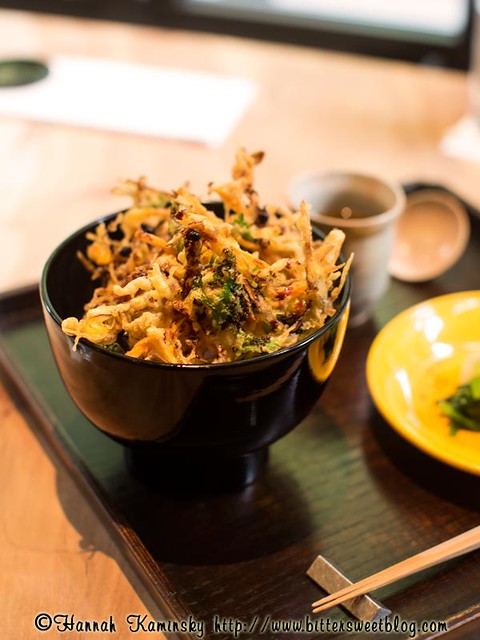
For those craving a bit of tempura, the Kakiage Donburi is sure to satisfy. Thin ribbons of various roots and gourds, with the incongruous handful of corn kernels mixed in, are expertly fried to a crisp consistency. The whole wispy jumble is perched upon sticky rice, and sides of miso soup and pickles round out the meal. Not a lick of grease is to be found here; you’d hardly know it was even deep-fried if not for the batter.

What makes Kajitsu a truly memorable experience, however, is still their carefully curated set menu. On this occasion, spring was in full force and the offerings gracefully reflected that transitory period from start to finish. “Ichi Ju San Sai” means “one soup and three dishes,” a format that ensures both balance and variety in a given meal. The rice is masterfully cooked, of course, but rather unexciting in comparison to the other culinary delights. Miso Soup always hits the spot, no matter how hot or cold the day is outside, and this particular interpretation held delicate strands of fresh yuba, reminiscent of an umami egg drop soup. After warming up on the savory, salty miso, the very next side brings some relief; chilled, refreshing, and wonderfully slippery…

Yes, the Spring Jelly would be best described as slippery, or perhaps gelatinous if one were feeling less charitable. It’s a texture that I happen to adore, but it may be more challenging for unfamiliar eaters. I hastily deconstructed the artful dish, plucking the finely shaved radish off the top and fishing out the jelly-like tokoroten noodles. Somewhat like a vegan aspic, the spring jelly itself was a melange of star-shaped crunchy vegetables, suspended in a dome of clear agar. The only thing I could positively identify in the mix was okra, since the other vegetables provided more crunch than flavor. Regardless of how strange that might all sound, may the record show that I adored this dish. No where outside of Japan would you ever find such a thing, and even then, I wouldn’t trust it to be without some fishy addition. This is what my memories of Japan taste like, and I only wish it was available a la carte so I could reminisce all year round.

The main event, Tofu with Ginger Sauce, arrived at the table in a heavy but shallow stoneware vessel, bubbling madly. Like a box full of edible treasures, the surprises never ceased with each successive bite. Sure there was tofu, both fresh and fried, plus a big dollop of freshly grated ginger just as promised, but it was otherwise nothing like what I had imagined. A starch-thickened sauce coated everything, infusing ginger into all the components. More of that chewy yomogi-fu made an unexpected cameo, and the addition of avocado was particularly inspired. Hot avocado rarely appeals, although something about how soft and tender it became, practically melting into the sauce itself, was utterly delectable. Though not a meal for the texturally challenged, I would it again any day, or every day if given the chance.

So how does the new Kajitsu compare to the old? It’s hard to make any definitive judgement so early on, although all signs point to greater success on the horizon. The very same spirit propels the establishment forward, while fresh inspiration pushes cooks and diners alike down a new path. I can’t wait to see where this new departure will lead.

Many thanks to Liz of Kosher Like Me for treating me to this unforgettable culinary adventure!

Wild About Frozen Blueberries

I’ve been feeling blue lately… And rather happy about that! Blueberries are abundant once again and my appetite for the sweet, mildly tart and tangy berries is insatiable. For as many punnets as I plow through, my cravings remain unsatisfied. Even as we reach the peak of growing season, the produce on offer left something to be desired. The solution turned out to be just a few steps away, hidden in plain sight. A more intense blueberry experience lay not in the produce aisle, but the freezer case. Frozen Wild Blueberries, grown in Maine and Canada but available worldwide and year-round, are a whole lot more special than you may realize.

Oh sure, frozen Wild Blueberries boast considerable nutritional advantages over conventional, cultivated varieties, such as an unbeatable antioxidant levels just for starters, but that’s not what first lured me over to the wild side. It’s all about the flavor, and they sure do pack a giant punch of it into such tiny packages. That means that you’re getting about twice as many berries per cup, each with less water and more concentrated sweetness than fresh. For a baker concerned about runny pie filling or “bleeding” muffins, such a vast advantage over the competition is invaluable.

Considering the sudden an unpredictable heatwaves rippling through the east coast lately, my thoughts were focused squarely on cooler, more refreshing treats. Referring back to Vegan a la Mode for inspiration, cheesecake sounded like a luscious pairing that would best highlight these indigo gems. Bumping up the intensity with a bold pop of citrus, lemon zest turned the simple flavor pairing into a legitimate flavor party. Enjoying a slowly melting scoop in a fresh waffle cone, the jam-like Wild Blueberry swirl shaking up the creamy confection with the periodically bite of a whole berry, it was exactly the summer-loving taste I had been missing

And yet, that still wasn’t enough. What could possibly take this simple, sweet delight to the next level of dessert perfection?

How about sandwiching it between two thick squares of graham cracker cookie bars, adding more cheesecake character back into the equation while incidentally creating more portable treats? Yeah, that might finally do the trick.

If you should find yourself at a loss for how to dress up your very own frozen Wild Blueberries, and are hungry for a slightly less indulgent sort of refreshment, a good place to turn is Cooking Light‘s latest cookbook, Chill: Smoothies, Slushes, Shakes, Juices, Drinks & Ices. Though not a specifically vegan cookbook, most of the recipes are “accidentally” vegan, and all the rest easily veganizable. Though it may seem like a random tip to throw into the ring, now is the perfect time to check it out and potentially win your very own copy. See the details over at the Wild Blueberry blog ASAP! After all, the only thing better than a Wild Blueberry ice cream treat might be one paired with a tall glass of ice-cold Blueberry-Ginger Juice (page 125.)

Wild Blueberry Cheesecake Ice Cream Sandwiches

Wild Blueberry Swirl:

5 Ounces (About 3/4 Cups) Frozen Wild Blueberries, Thawed
2 Tablespoons Granulated Sugar
1 Teaspoon Lemon Zest
1 Teaspoon Cornstarch

Graham Cracker Cookies:

3/4 Cup Non-Dairy Margarine
1/4 Cup Dark Brown Sugar, Firmly Packed
3 Cups Finely Ground Graham Cracker Crumbs
2 Tablespoons Whole Flaxseeds, Ground
1/2 Teaspoon Salt
1/4 Teaspoon Ground Cinnamon
2 Tablespoons Vegan Sour Cream or Plain Yogurt

Lemon Cheesecake Ice Cream:

1/2 Cup (4 Ounces) Vegan Cream Cheese
1/3 Cup Granulated Sugar
3/4 Teaspoons Vanilla Extract
1 Cup Plain Non-Dairy Milk
1 Teaspoon Lemon Zest
Pinch Salt

Prepare the blueberry swirl first since it will take the longest to cook and fully chill. Combine all the ingredients in a medium sauce pan, stirring well before turning on the heat to break up any possible lumps of starch. Cook over medium heat, stirring periodically, until the mixture comes up to a full boil. Turn down the heat slightly so that it stays at a lively simmer, and cook for 1 minute longer, until thickened.

Remove from the stove, cool to room temperature, and then place in the fridge to chill until cold; about 2 – 3 hours.

Moving along to the graham cracker cookie, preheat your oven to 350 degrees and lightly grease a 9 x 13-inch rectangular baking pan.

Place the margarine and sugar in the bowl of your stand mixer, and cream the two together using the paddle attachment. Once thoroughly beaten and homogeneous, pause the mixer and add in the graham cracker crumbs, ground flaxseeds, salt, cinnamon, and vegan sour cream or yogurt. Starting at the lowest speed, allow the mixer to gently incorporate the newest addition, and continue stirring until the entire mixture is moist will stick together when pressed.

Transfer to your prepared pan and spread it out evenly over the bottom. Press it firmly into a smooth layer, using your hands or the bottom of a flat measuring cup.

Bake for 12 – 15 minutes, until golden brown. Let cool completely before turning the whole cookie sheet out of the pan and onto a cutting board. Use a very sharp knife to slice it cleanly down the middle, forming two equal pieces. Trim away the dark edges so that it measures about 8 inches wide and 5 – 6 inches long.

Line an 8 x 8-inch square baking pan with aluminum foil, and carefully place one of the squares inside, fitting it snugly against three of the four edges. Pull the foil up against the remaining side that comes up slightly short. Place the pan and the remaining square of graham cracker cookie in the fridge.

Meanwhile, the ice cream itself comes together very quickly. Simply pile all of the ingredients into your blender and puree briefly, just until smooth. Blend no longer than necessary to prevent the mixture from warming up.

Pour the ice cream base into your ice cream maker and churn according to the manufacturer’s instructions. Pull out your square baking pan and spoon the soft ice cream on top of the graham cookie sheet inside. Smooth out the ice cream to evenly cover the cookie. Spread the blueberry swirl mixture on top, and use a spatula to swirl both components together. Finally, place the remaining rectangle of graham cracker cookie on top, and press down gently. Immediately move the pan into your freezer and let rest until solidified; at least 8 hours and ideally 12 or more. Slice the large ice cream sandwich into smaller rectangles and enjoy.

Makes 9 – 12 Ice Cream Sandwiches

Printable Recipe

This post was written for and is sponsored by Wild Blueberries, but all content and opinions are entirely my own.